
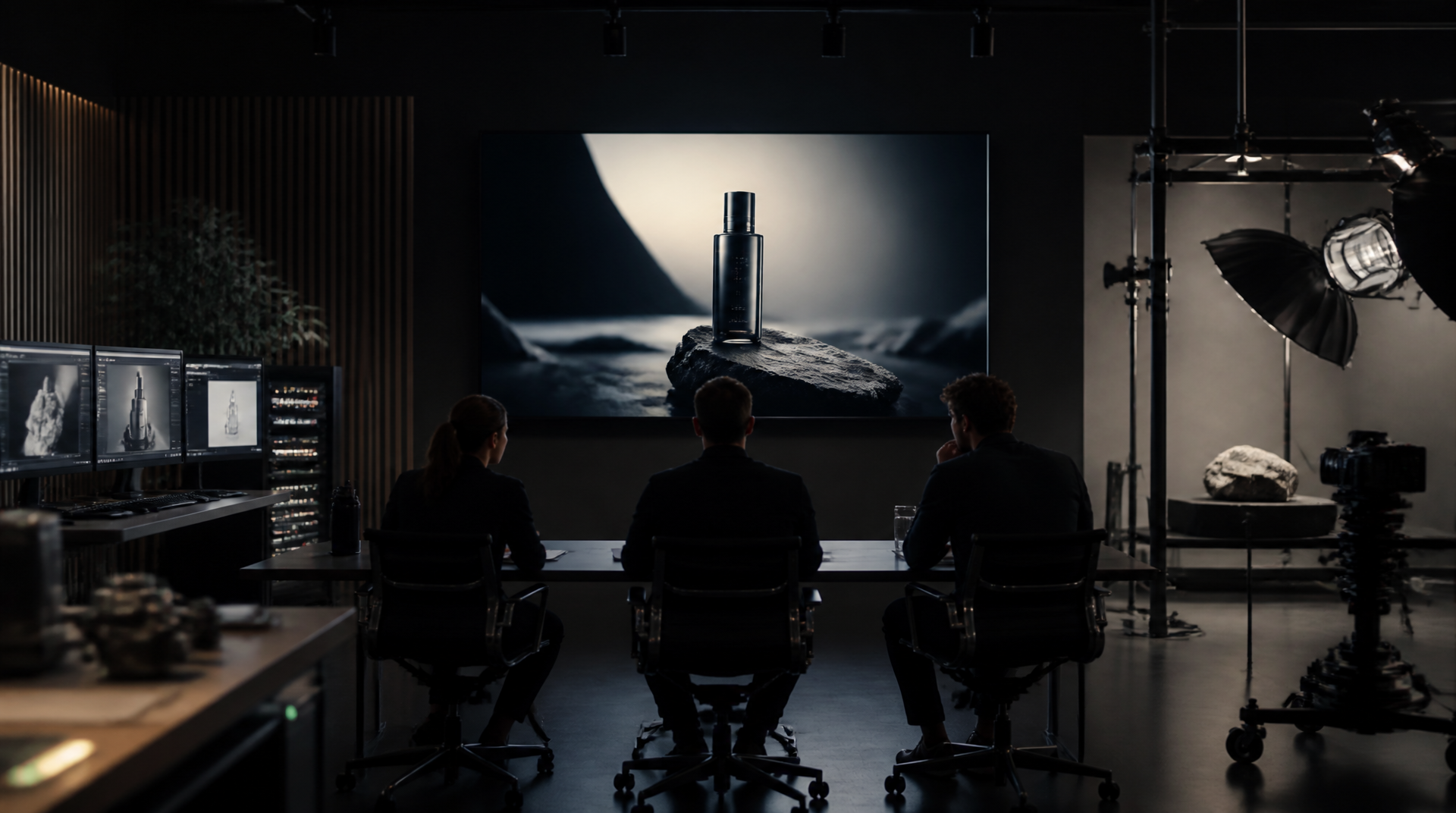
The wrong question is usually the loudest one.
Can AI replace traditional production?
That framing sounds modern, but it is too shallow to help a brand make a real decision.
The better question is:
Which production jobs became faster, cheaper, or more flexible because of AI, and which jobs still decide whether the commercial feels credible, premium, and commercially useful?
If a team mixes those categories together, two bad outcomes appear fast.
Either the project stays too heavy and slow because every old production habit remains untouched, or it becomes fast in the wrong places and cheap in the places the audience actually notices.
That is why the useful comparison is not AI hype versus old-school craft.
It is production leverage versus production responsibility.
The real shift is not that production disappears
Traditional production was never only about the camera.
It was also about coordination:
when the team sees options,
how expensive each new direction becomes,
how many scenes can be tested before commitment,
who can review the work early,
and how easily one hero asset turns into placement-ready derivatives.
AI changes those economics.
It lets a team probe visual territory earlier, test more controlled options before a full commitment, and build variant logic sooner.
What it does not do is remove the need for a commercial idea, brand taste, product truth, editing judgment, or approval discipline.
That is the first thing many teams miss.
The machine reduces friction.
It does not remove authorship.
What actually changes in AI commercial production
1. Concept probes can happen before the heavy commitment
In a traditional production path, many decisions stay expensive until the crew, location, talent, lighting, and schedule are locked.
In an AI-first path, the team can test the campaign direction much earlier.
That does not mean generating a hundred random looks.
It means building a few intentional probes:
one proof-led opening,
one atmosphere-led opening,
one product-first frame language,
one version with stricter realism,
one version with more stylization.
This is useful because the team can learn faster where the commercial should live before it spends energy finishing the wrong idea.
2. References become operational, not decorative
In weak AI workflows, references are moodboard wallpaper.
In strong AI workflows, references become operating instructions.
The team decides:
which frame has authority,
which material cues cannot drift,
which lighting rules define the world,
which camera behavior is allowed,
which brand signals are forbidden.
Traditional production still uses references, but AI production makes reference discipline even more important because the system will happily produce attractive drift if nobody ranks visual authority clearly.
3. Asset families can be designed earlier
A traditional commercial often treats derivatives as a later adaptation step.
An AI commercial can plan the family much earlier:
hero cut,
shorter paid cuts,
product proof inserts,
landing-page loops,
vertical variants,
market or language adaptations.
That changes the workflow because the team is no longer thinking only about one final export. It can think in asset roles from the beginning.
When done well, that creates more leverage from one approved world.
When done badly, it creates a folder full of disconnected outputs that all feel almost right and commercially weak.
4. Iteration no longer depends on the same reshoot logic
Traditional production often forces an expensive question:
Do we need another shoot day to fix this?
AI changes that.
Some fixes move upstream into references, prompt structure, scene constraints, selection, or edit design instead of requiring a full physical reset.
That is a real advantage.
But it only helps if the team knows what it is trying to fix.
Otherwise the project becomes a restless loop of more generations with less clarity.
5. Approval should happen in smaller gates
Traditional production often creates one big presentation moment.
AI production works better with smaller gates:
approve the commercial job,
approve the visual territory,
approve the proof scene logic,
approve the usable direction,
approve the final cut and derivatives.
This is one reason AI can feel faster without becoming chaotic.
The project does not wait for one giant reveal. It keeps moving through narrower, clearer decisions.
What still cannot be skipped
The commercial job
The team still has to answer one simple question:
What is this commercial trying to make the buyer feel, understand, or do?
If that is vague, AI only multiplies ambiguity faster.
No model fixes a weak commercial job.
Product truth and claim boundaries
This is where many AI-first teams become overconfident.
The label bends.
The finish becomes more beautiful and less true.
The demo implies a product behavior that does not exist.
The scene accidentally promises more than the landing page can support.
Traditional production had its own version of this problem, but AI can hide the error inside attractive output.
That is why a serious team still needs:
product truth notes,
claim boundaries,
banned signals,
and clear rejection rules.
If the asset is carrying proof, those controls are not optional.
Taste and hierarchy
AI can generate impressive surfaces.
It cannot be trusted to decide which moment deserves emphasis, which frame cheapens the brand, which detail breaks the illusion, or when the commercial becomes too loud for its own message.
Premium work still depends on hierarchy:
what the viewer notices first,
what should stay quiet,
what should feel expensive,
what should be cut even if it took effort to generate.
That is not a compute problem.
That is judgment.
Editing authorship
A commercial is not a slideshow of strong frames.
It still needs pacing, escalation, silence, contrast, and a clean reason to keep watching.
AI can expand options for scenes and motion, but final edit authorship still decides whether the result feels directed or assembled.
Real-world proof where scrutiny is high
There are still cases where reality should lead:
tactile product proof,
regulated or literal accuracy,
close inspection of packaging or labels,
physical handling the buyer will study closely,
licensed talent or real-person likeness constraints,
food, texture, or material behavior that must survive scrutiny.
This does not make AI weak.
It simply means the team has to separate atmosphere from evidence instead of pretending every shot carries the same burden.
What to test first before replacing a traditional step
If a brand wants to introduce AI into commercial production intelligently, the first test should stay narrow.
Start with one controlled commercial problem:
Write the job of the asset in one sentence.
Define one proof scene or one emotional scene to test first.
Lock the non-negotiables: product truth, brand rules, banned cues, claim limits.
Decide what would make the test usable, risky, or dead on arrival.
Generate a small set of probes instead of a giant volume batch.
This is where many teams save money.
They stop asking AI to replace the whole production model at once and start asking it to prove one commercial role clearly.
Where teams usually waste money
They generate before deciding what changed
The workflow changes, so the team assumes the strategy changed too.
It did not.
The team still needs to know the buyer problem, the proof structure, and the role of the asset.
They use AI speed to avoid hard decisions
More options can become a way to postpone taste.
That feels productive.
It is often avoidance in a more cinematic costume.
They remove real production from the wrong shots
If the frame must defend material truth or literal proof, AI-only may be the wrong leadership layer.
Hybrid production is often smarter than ideological AI-only production.
They treat rough possibilities like finished advertising
An early AI direction can be strategically useful without being publication-ready.
Weak teams confuse those levels.
Strong teams keep the difference clear.
They lose the production memory
Without memory, each round restarts:
the same references get rediscovered,
the same mistakes get regenerated,
the same weak direction gets argued over again,
and the cost advantage starts leaking away.
When AI should lead and when traditional production should still lead
AI should usually lead when the brand needs:
early concept territory tests,
campaign world exploration,
controlled variant maps,
product-adjacent atmosphere,
previsualization before heavier production,
fast cutdown logic,
multilingual or placement adaptations from one approved world.
Traditional production should still lead when the brand needs:
exact physical evidence,
human performance with real-world nuance,
tactile credibility under close scrutiny,
hard-to-fake interaction with product or environment,
legal or retail-sensitive accuracy,
or a hero moment whose trust depends on reality itself.
The mature answer is often not either/or.
It is:
Use AI where leverage improves the system, and keep reality where scrutiny makes substitution expensive.
What Gateway Studio should own in this workflow
Gateway Studio should not only store generated media.
It should own the production memory:
approved commercial job,
reference stack,
product truth notes,
claim boundaries,
tested scene probes,
rejected directions and why they failed,
strongest derivatives by placement,
and the handoff logic for final edit and publishing.
That is how AI production becomes compounding instead of repetitive.
The point is not only to produce one commercial faster.
The point is to make the next commercial smarter.
The practical takeaway
AI changes a lot in commercial production.
It changes how early a team can see options, how cheaply it can test visual territory, how quickly it can build variants, and how flexibly it can adapt one approved world across placements.
What it does not change is the responsibility for direction.
Commercial clarity, product truth, brand taste, edit hierarchy, and review gates still decide whether the work feels premium or disposable.
That is why the smartest production model is rarely:
replace traditional production.
It is:
rebuild the workflow so AI carries the right jobs and the human team keeps ownership of the decisions that actually matter.
No. AI changes how early a team can test direction, how cheaply it can explore variants, and how flexibly it can adapt one approved world. It does not remove the need for a commercial idea, product truth, editing judgment, or review discipline.
Next move