
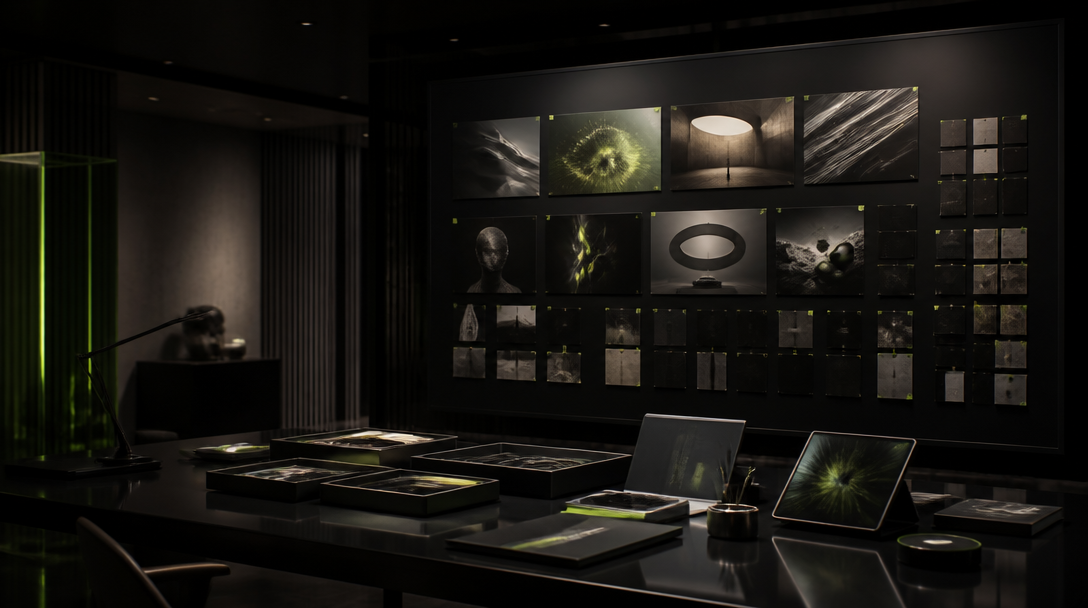
The AI speed story is usually told backwards.
Teams assume generation is the bottleneck. In practice, the real drag appears between the generations: references get scattered, approvals lose context, the winning frame disappears into chat history, and the next round starts as if the last one never happened.
That is why a serious AI production workflow needs more than tools. It needs a workspace.
Faster is only useful if direction survives
Speed matters. But speed by itself is cheap.
If the team can generate ten times faster and still loses the product truth, the mood references, the rejected directions, the selection logic, and the delivery plan, the project has not become more efficient. It has only become more chaotic at a higher rate.
The useful promise of an AI creative workspace is narrower and stronger:
keep the campaign context in one place,
reduce restart work between rounds,
protect the approved direction,
make the next production decision easier.
That is different from a gallery of outputs. A gallery proves that images exist. A workspace proves that the project still has memory.
Where production time actually gets lost
Most production delay does not come from waiting for one more render.
It comes from operational leakage:
the brief lives in one note, while the references live in another folder,
the best output is saved, but the reason it won is not,
the team remembers what was rejected, but not why,
the launch package gets built asset by asset instead of as one connected system,
a client asks for one revision and the whole visual logic has to be reconstructed from scratch.
This is the hidden tax in scattered AI production.
Without a workspace, the team keeps paying to rediscover its own decisions. That is why the process feels fast in the first hour and slow by the third round.
The five workspace layers that change speed
A real production workspace changes speed because it compresses repeated decisions into reusable structure.
1. One campaign room
The campaign needs a home for the job itself: what is being made, for whom, for which placement, and with what visual rules.
That sounds simple, but it is the boundary that stops a campaign from turning into disconnected prompt experiments.
2. Reference memory
Strong output usually starts with references, not with a clever sentence.
When references, mood boards, product truth, composition notes, and approved examples stay together, the next round starts from a real visual world instead of from improvisation.
3. Rejection memory
This is where many teams lose the biggest speed advantage.
A rejected direction is still useful if the rejection reason is visible:
too glossy for the brand,
wrong product scale,
promising composition but weak lighting,
good hook frame but wrong audience signal.
That memory prevents the team from repeating expensive mistakes under a new prompt.
4. Selection and approval memory
Production gets faster when the chosen direction is visible, not when every option remains equally alive.
The workspace should make it obvious which frame won, what changed after review, and what is now stable enough to expand into variants, edits, or launch assets.
5. Delivery structure
The last speed gain is not inside generation. It is inside packaging.
If the winning direction can move straight into launch stills, paid variants, storyboard frames, social crops, or avatar extensions without being rebuilt manually, the workspace has done real work for the team.
That is the point: faster from concept to usable package, not only faster from prompt to image.
What a workspace does not replace
This matters just as much as the speed claim.
A workspace does not replace:
creative direction,
commercial judgment,
brand taste,
client conversations,
final editorial selection.
It does not decide what the campaign should say. It does not know which frame supports the business moment. It does not protect the brand by itself.
Human direction is still the layer that decides:
what the asset is for,
what should be rejected,
what must stay true,
what becomes the final delivery.
That is why the strongest framing is not “AI replaced the process.”
The stronger framing is: the workspace removes production friction so human direction can stay focused on the decisions that actually matter.
When Gateway Studio helps most
Gateway Studio makes the most sense when the team has a real visual production problem, not just curiosity about tooling.
The fit is strongest when the brand needs:
many launch assets from one approved direction,
campaign visuals that will go through several review rounds,
a repeatable system for image, video, or avatar work,
production memory that survives beyond one chat thread,
a bridge between agency direction and in-house production speed.
In those moments, the workspace becomes operational leverage.
The team is no longer starting from zero every time. It is building from an authored visual system.
What a team should prepare before opening the workspace
The workspace works best when the inputs are serious.
Before the first production round, the team should already know:
the offer or launch moment,
the audience and buying context,
the placement where the asset must work,
the brand signals that are allowed or forbidden,
the product or service details that must stay true,
who owns approval and who owns the next decision.
If those basics are missing, the workspace will still create motion. It just will not create clarity.
That is an important distinction. Good systems accelerate structure. They do not invent it.
Closing thought
An AI creative workspace is valuable when it makes the production process easier to continue, not merely easier to start.
That is the real speed advantage.
The first generation round can happen almost anywhere. The harder question is whether the second, third, and fourth rounds still remember what the campaign is trying to become.
When that memory stays intact, speed stops looking like noise and starts becoming a real production advantage.
No. The useful difference is production memory: references, rejected directions, approvals, and selected outputs stay connected so later rounds do not restart from zero.
Next move