
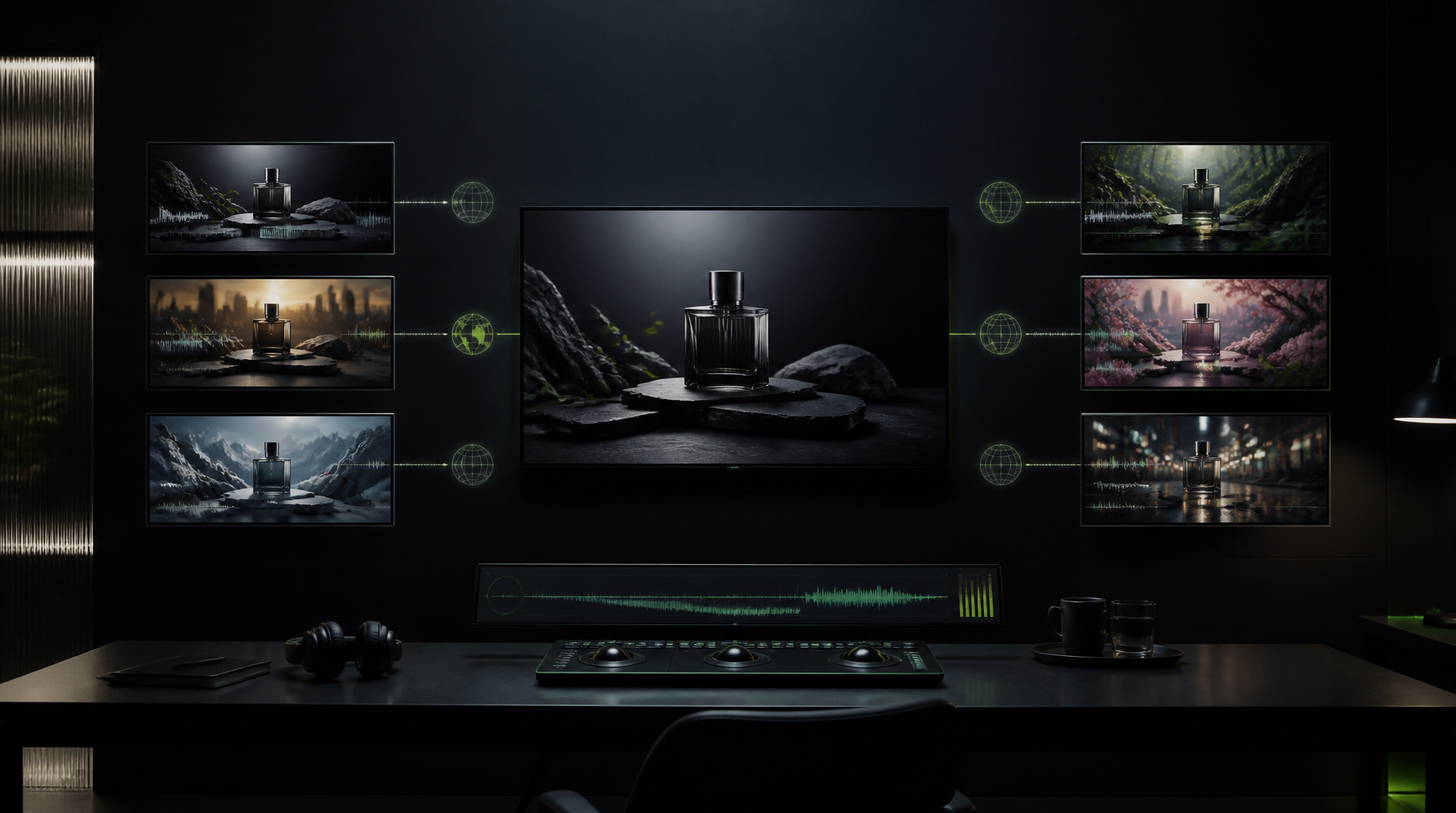
Most teams localize AI video too late.
They make one hero cut, decide it works, then ask for subtitles, voice swaps, trimmed hooks, or translated on-screen copy after the asset is already emotionally locked.
That is not a localization workflow.
It is a salvage workflow.
The result usually looks familiar: the original market gets the sharp version, while every additional language gets a compromised edit with denser captions, weaker timing, softer claims, and a brand voice that no longer feels authored.
The expensive part is not the translation bill.
The expensive part is rebuilding confidence after the localized versions start to feel cheaper than the original.
The better system starts earlier. Instead of treating localization as a final pass, treat the campaign as a master scene system from the beginning.
That means one controlled scene logic, one proof logic, one packshot logic, one approval logic, and a clearly separated market layer for language, voice, subtitles, legal nuance, and CTA adaptation.
Translation changes words.
Localization changes decisions.
Translation is only one layer of the job
When brands say they need multilingual AI video, they often mean they need the same ad in three, six, or twelve markets.
But "the same ad" is not a real production unit.
One market may tolerate denser subtitles. Another needs a slower spoken rhythm. One can open on product first. Another needs the problem named first. One market can use price framing in the first seconds. Another needs softer context before the CTA.
If the team localizes only the script, the video still breaks somewhere else:
subtitle density becomes unreadable,
timing no longer fits the cut,
the voice sounds borrowed from a different brand,
the product proof sits under the wrong sentence,
the disclaimer arrives too late,
or the final CTA feels imported instead of native.
That is why a text-first localization pass usually underdelivers.
The system has to localize the scene, not just the sentence.
The master scene is the asset, not the first English cut
A useful master scene is not simply the first approved export in English.
It is the controlled production logic that every market version inherits.
That logic includes:
the buyer problem the scene answers,
the proof the scene must show,
the emotional temperature of the ad,
the visual constants that cannot drift,
the type of voice the brand will allow,
the moments where copy can change,
and the boundaries around claims, disclaimers, and CTA behavior.
Once that is defined, the English version is no longer the "real" ad and every other version a downgrade.
Instead, the campaign has a master scene system and each market gets a justified adaptation of the same directed asset.
This is where AI becomes useful.
AI can accelerate voice tests, subtitle variants, pacing options, alt intros, product copy swaps, and market-specific adaptation.
But it only helps if the master scene already knows what must stay true.
What should be locked before the first render
Before the team generates the first scene, six things should be explicit.
Claim and proof
What is the strongest promise in the ad, and what must be visible on screen to support it?
If the claim shifts between languages while the proof stays fixed, trust drops immediately.
Visual constants
What can never drift between markets?
Usually this means product silhouette, material truth, packaging, brand color behavior, camera language, finishing treatment, and the final packshot rhythm.
Voice role
Who is speaking?
Founder, operator, neutral narrator, product explainer, brand character, or local presenter are not interchangeable choices. The role changes authority, warmth, and risk.
Subtitle policy
How dense are subtitles allowed to become before the ad stops feeling premium?
Some markets need more text to preserve meaning. That is fine. The rule is to redesign pacing or edit length before the subtitle layer becomes a wall.
Market CTA logic
What should the final action feel like in each market?
Book a call, request a concept, view campaign work, or open a landing page are different commitments. The CTA should match local funnel reality, not only the original edit.
Legal and disclosure ownership
Who decides whether a market needs a claim softener, disclosure line, local approval, or a different phrasing standard?
If nobody owns this before generation, the team learns too late.
Separate the master layer from the market layer
The simplest operational move is to split the asset into two layers.
The master layer holds what the brand protects globally:
scene idea,
proof logic,
product truth,
core edit rhythm,
camera grammar,
visual finish,
packshot structure,
brand voice boundaries.
The market layer holds what can and should adapt:
spoken language,
subtitle line breaks,
local phrasing,
offer emphasis,
disclaimer phrasing,
CTA label,
cadence of the first hook,
market-specific crop or platform sequencing.
This split does two useful things.
First, it stops teams from accidentally rewriting the whole ad every time a new market is added.
Second, it makes review much faster because everyone knows which decisions are global and which are local.
Without that split, localization meetings become vague arguments about taste.
With it, the team can say something precise:
The master scene stays. The subtitle pacing changes. The CTA changes. The claim wording softens. The proof shot remains untouched.
That is a real production sentence.
Where AI helps without making the work generic
AI is valuable in localization when it compresses iteration around a controlled asset.
Useful uses include:
trying two or three voice temperatures before recording or synthesizing the final local voice,
testing subtitle timing options before full finishing,
adapting a founder script into shorter market hooks without changing the thesis,
swapping localized product surfaces or packaging details when the market truly differs,
generating internal scene previews for market reviewers before final edit time is spent,
and building multiple cutdown variants from one approved scene system.
The weak use of AI is different.
That version asks the model to "make this work for Germany, Spain, and Brazil" without a master scene, without claim boundaries, and without a clear approval owner.
That is not localization leverage.
That is brand drift at scale.
Why localized versions often feel cheaper than the original
The problem is usually not that a translated line sounds imperfect.
The problem is that the localized cut reveals where the original asset was too fragile.
Maybe the scene depended on very short English phrasing. Maybe the product proof only matched one sentence. Maybe the voice depended on a specific cultural tone. Maybe the edit rhythm could not survive denser subtitles. Maybe the packshot was too compressed to hold a local disclaimer.
Localization does not create those weaknesses.
It exposes them.
That is why multilingual versioning is a useful stress test. It shows whether the campaign was built like a robust system or like a single polished demo.
Premium work survives translation because the idea is structurally clear.
Cheap work collapses because it was only visually impressive in one language.
The review gate every market needs
Before a localized version goes live, the market review should answer five things.
Is the claim still true in this language and market context?
Does the proof still arrive under the right line?
Does the voice still sound like the brand, not like a generic dubbing layer?
Are subtitles, supers, and CTA pacing still readable and premium?
Would a local operator defend this version without apologizing for it?
If the answer to the last question is no, the asset is not localized enough, even if the translation is technically correct.
A practical rollout for one campaign
For a real campaign, the sequence can stay simple.
Define one master scene with one buyer problem and one proof job.
Lock the claim boundary, packshot logic, and voice role before generation.
Generate or edit the master asset until the idea is strong without market clutter.
Create a market adaptation sheet for each locale: hook, phrasing, subtitle density, disclaimer needs, CTA, and placement.
Produce local variants only against that sheet.
Review each market cut as a real ad, not as a translation artifact.
Store what changed so the next campaign starts with stronger defaults.
That last step matters more than most teams think.
If localization decisions stay trapped inside one project file, the brand keeps paying to relearn the same lesson.
What this changes for a brand team
A master scene system turns localization from a panic task into a compounding asset.
Now one campaign can produce:
a hero cut,
local language variants,
platform cutdowns,
founder or narrator alternates,
landing page loops,
paid social openers,
and regional CTA versions
without every new request feeling like a new production from zero.
That is where AI belongs in the workflow.
Not as a magical translator after the fact, but as a force multiplier inside a directed versioning system.
The final rule
If a market version feels like a diluted copy of the original, the problem is usually not the market.
The problem is that the campaign never had a master scene system to begin with.
The strongest multilingual AI video work does not ask how to translate one finished ad.
It asks how to build one directed asset that can survive many markets without losing authority, proof, or taste.
That is the difference between localization as cleanup and localization as production design.
Citable framework
Master scene system for multilingual AI video
Localization should inherit one directed scene system: buyer problem, proof scene, claim ceiling, voice role, packshot logic, subtitles, and local review gates.
- 01Global layer: scene job, proof, visual constants, product truth, and forbidden claims.
- 02Local layer: hook, voice, subtitle length, cultural phrasing, and market CTA.
- 03Review layer: check the localized cut as an ad, not as a translated file.
Treating localization like a final translation task after the hero cut is already locked. That usually forces subtitle, timing, voice, and proof compromises that make the localized ad feel weaker than the original.
Next move