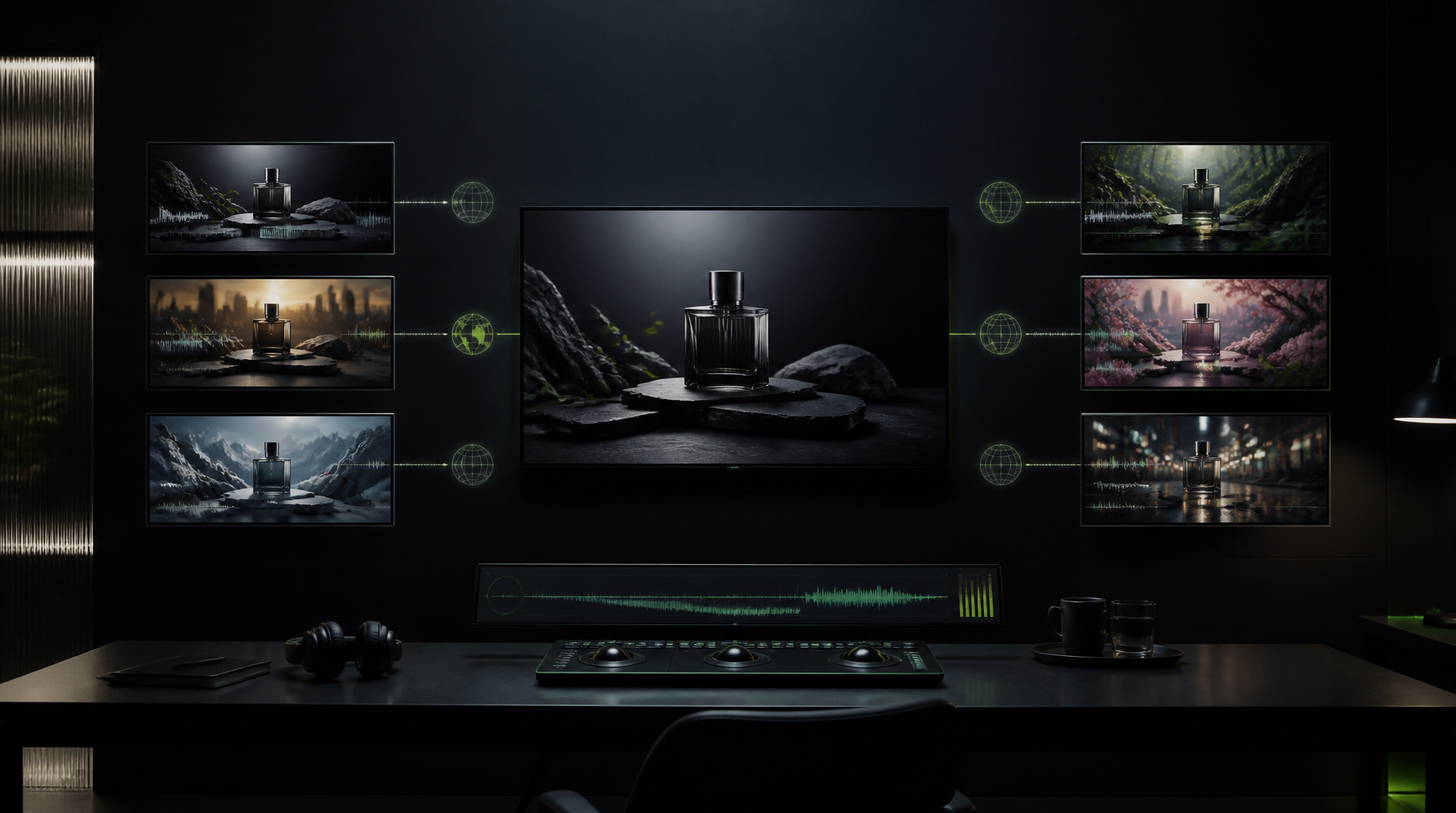
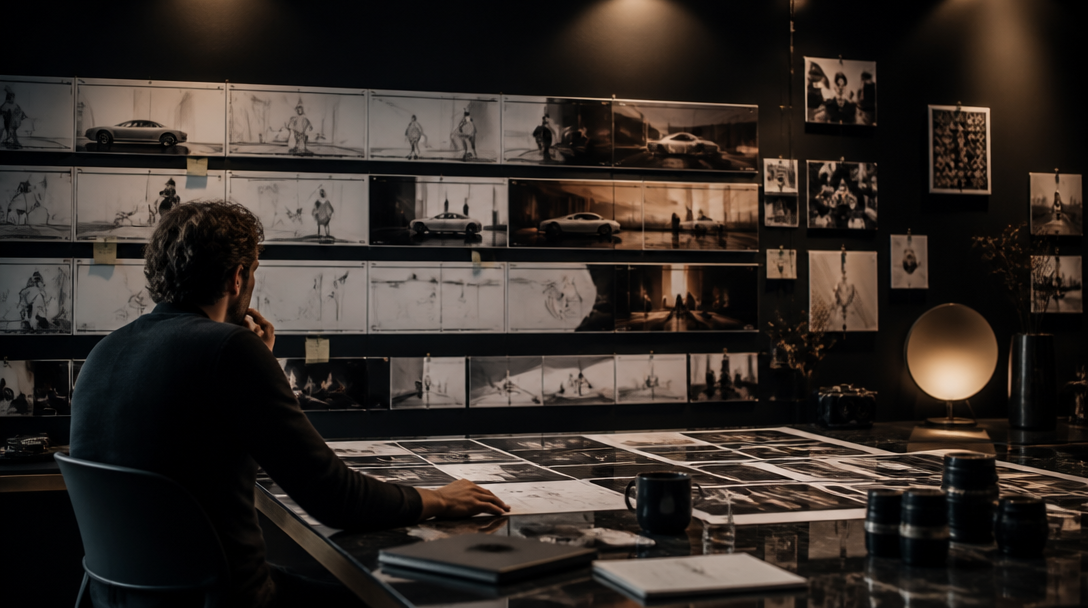
Many brand teams think the storyboard is the hard part.
It is not.
The hard part is deciding what each shot is allowed to do before the model starts inventing motion, emphasis, and continuity on its own.
A storyboard can show the right frames and still create the wrong video.
That happens when the board describes what the campaign should look like, but never defines what the shot must protect.
One frame wants product truth.
Another wants appetite.
Another wants premium motion.
Another wants performance clarity.
If those jobs are not separated, the model starts blending them into a smooth but unreliable compromise.
That is why the useful AI video question is no longer "do we have a storyboard?"
The useful question is: what shot rules must stay true before generation starts?
A storyboard is a promise, not a control system
A storyboard is still useful.
It helps a team agree on sequence, tone, and visual ambition.
But a storyboard usually does not answer the operational questions that make AI video stable:
which frame carries literal proof,
which frame is allowed to be atmospheric,
when the camera may move,
what must stay visually consistent between shots,
what the model is forbidden to stylize away,
and what change would count as a failure even if the render still looks beautiful.
That gap matters more in AI video than it did in traditional production.
On a live set, the team can catch drift while shooting. The product is physically present. The director can correct blocking. The camera crew can protect continuity. The client can see what is becoming true in the room.
In AI generation, the first render is already an interpretation.
If the rules were vague, the model makes the missing decisions for you.
That is usually where continuity starts breaking.
The bottle gets slightly taller.
The hand changes character.
The packshot becomes more dramatic but less trustworthy.
The "proof" shot quietly starts behaving like an atmosphere shot.
The team then blames the model when the deeper problem was that the storyboard never became a shot system.
What shot rules actually need to be locked
For brand work, shot rules should usually define five layers before the first render.
1. The job of the shot
Every shot needs one commercial job.
Not three.
Not "kind of everything."
Ask whether the shot is there to:
prove the product,
create desire,
show workflow or use,
establish premium atmosphere,
or open curiosity for the next beat.
If one shot is carrying proof, desire, feature explanation, founder trust, and CTA pressure at the same time, it becomes fragile fast.
2. The proof surface
Decide what must stay literally true in that shot.
It may be:
product geometry,
pack or label layout,
a UI state,
skin or fabric texture,
spokesperson identity,
hand placement,
or the exact claim boundary around what the video may imply.
This is the layer the model is not allowed to improvise over.
3. The camera lane
Lock how the shot is allowed to move.
That means:
static, locked-off, or handheld,
push-in versus side drift,
wide-to-tight or tight-to-wide,
when motion begins,
and whether the shot is continuous or designed to cut.
Teams often describe style without describing camera behavior. Then a brand proof shot suddenly behaves like a trailer insert.
4. The continuity rule
Define what must survive across the shot family.
That includes:
product silhouette,
lighting direction,
spokesperson wardrobe or facial logic,
environment hierarchy,
palette,
interface state progression,
and the relationship between hero frames and supporting variants.
Continuity is not decoration. It is what lets the viewer believe the campaign still belongs to one directed world.
5. The forbidden drift
Write down what the model must not do.
Good forbidden rules are concrete:
no label drift,
no invented buttons or ports,
no beauty lighting that hides the material truth,
no random extra props,
no fake hand positions that misrepresent usage,
no premium atmosphere at the cost of credibility,
no scene redesign that weakens the original claim.
This is often more useful than adding more adjectives.
What to test first
Do not start with the full hero film.
Start with one shot family that exposes the exact thing you are afraid will drift.
Good first tests:
one product proof shot with a modest camera move,
one spokesperson shot that keeps identity stable across three angle variations,
one UI-led scene where the interface cannot mutate,
one atmosphere shot that must stay premium without stealing the role of proof,
one cutdown variation built from the same shot rules as the hero version.
The first test should answer one workflow question, not prove the whole campaign.
That gives the team a clean read on the system:
Did the camera rule hold?
Did the proof surface stay intact?
Did the continuity survive a variation?
Did the shot still do the job it was assigned?
If the answer is muddy, the next step is not "generate more."
The next step is to tighten the shot rule that failed first.
Which settings and constraints matter most
Different tools name the controls differently, but the same production constraints keep showing up.
The most important ones are usually:
Reference priority
If the tool lets you combine image, video, style, or text references, decide their internal rank before upload. A product truth frame should not have the same authority as a mood frame.
Duration and cut logic
Shorter tests are better for first-pass stability. If the shot can prove itself in a shorter controlled span, you learn more quickly which part breaks first.
Camera consistency
A stable instruction about camera behavior is often more valuable than extra stylistic language. "Locked-off proof shot with a slow push after the label becomes legible" is stronger than a cloud of adjectives.
Stylization ceiling
The team should know how far the image may be stylized before it stops serving the category. Luxury beauty, food, hardware, and SaaS interface videos all break in different places.
Variant inheritance
If the first approved shot becomes paid variants, social cutdowns, or localization inputs, lock what must inherit unchanged from the master shot.
Failure criteria
Name what makes a render unusable even if people initially like it. That prevents a beautiful wrong answer from surviving because the room was tired.
What breaks most often
In practice, AI video storyboards usually fail in one of these ways.
The board is visually right but commercially vague
The sequence looks smart, but no shot has one clear job. The model fills the ambiguity with spectacle.
The proof shot behaves like an atmosphere shot
The render looks expensive, but the product, interface, or claim stops feeling reliable.
The camera language changes role midstream
The first shot is disciplined, the next one starts selling emotion, and the cut no longer protects the original message.
Variants stop inheriting the same world
Paid cutdowns, vertical crops, or localization passes no longer feel like the same campaign because the master shot rules were never written down.
The team confuses a pretty render with a stable system
One good output does not prove that the workflow is under control. It may only prove that the model guessed correctly once.
What Gateway Studio should own
This is the part most teams underestimate.
The job is not only to store prompts or exported clips.
Gateway Studio should own the shot system around them:
the business job of each shot,
the proof surface attached to that shot,
the approved reference hierarchy,
the camera lane,
the continuity rules for the shot family,
the forbidden drift list,
the rejected outputs and why they failed,
and the exact inheritance rules for future variants.
That is what turns a storyboard from a nice planning artifact into production memory.
It also gives the next round a better starting point than "make it like the good one from last week."
If your team is already comparing new mixed-input workflows such as Gemini Omni for Brand Video, or building multilingual versions from one approved scene system as described in AI Video Localization Needs a Master Scene System, the same rule applies:
the tool gets smarter only when the shot logic gets stricter.
The premium outcome is not more storyboards.
It is a storyboard that has already been translated into shot rules before the first render.
Because a storyboard usually shows sequence and tone, but not the operational rules that keep the render stable: what the shot must prove, how the camera may move, what continuity must survive, and what drift is unacceptable.
Next move