The dangerous thing about ChatGPT Images 2.0 is not that it makes ugly work.
It is that it can make the room feel finished too early.
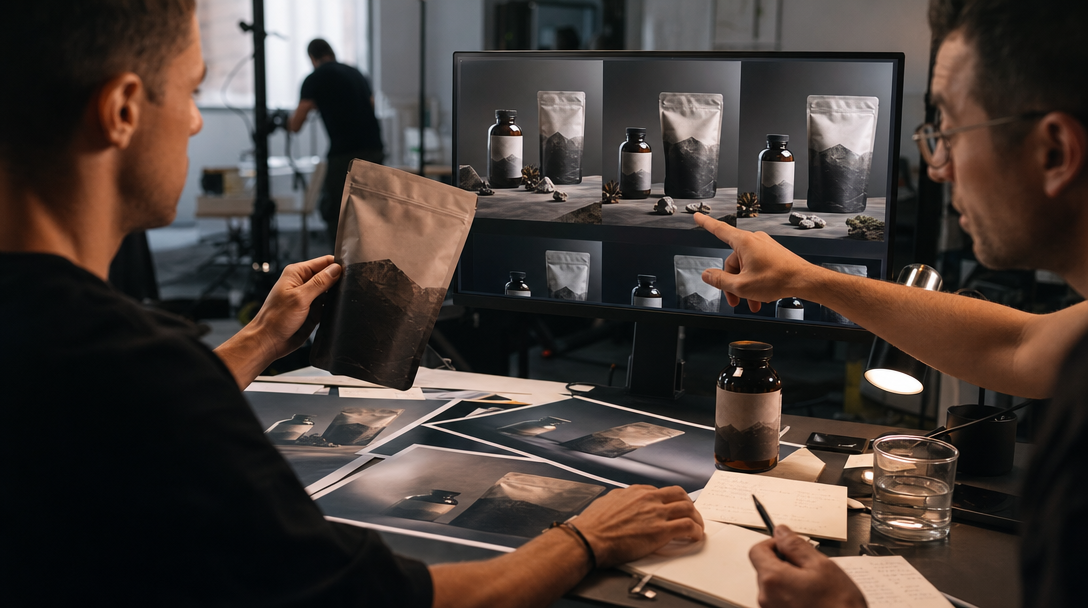
Take a premium supplement launch. The team has one approved pack shot, one rough landing-page wireframe, and a founder who wants three paid-social directions before the afternoon review. Someone opens ChatGPT Images 2.0, asks for a warmer kitchen scene, a tighter crop, better headline space, and a cleaner hand position. Ten minutes later the room has frames that look surprisingly close to a campaign.
That speed is real. So is the trap.
The cap geometry may have drifted. The flavor band may be softer than the real product. The hand pose may imply an easier opening motion than the pack actually allows. And the tiny line of text near the claim may look believable while saying something nobody approved.
OpenAI is positioning Images 2.0 around stronger instruction following, cleaner edits, and better text handling. That makes it far more useful for commercial image work than the old "just give me a pretty render" generation loop. It does not make the model an approval system.
For Gateway, that distinction matters. ChatGPT Images 2.0 belongs in the production room. It just should not be the person signing off on product truth, claim truth, or interface truth.
The real risk is early confidence, not obvious failure
Weak image models usually announce themselves. The hands melt, the product floats, the background looks synthetic, and nobody serious mistakes the output for a final asset.
Images 2.0 creates a harder problem. The frame can look close enough that people stop asking the useful questions.
Imagine a canned beverage ad. The team wants a faster summer variant of an approved key visual. The model gives them a colder countertop, brighter fruit, a stronger splash accent, and tighter composition. Everyone likes it because the direction feels sharper. Then the media buyer zooms in and notices the tab shape changed, the metal curve flattened, and the can now feels more like a concept poster than the real product the landing page will show after the click.
Or take a SaaS campaign. The art director uses Images 2.0 to reshape a dashboard hero, simplify the color noise, and create room for a stronger headline. As a concept frame, it is useful. As product proof, it becomes risky the second the screen state suggests a real workflow the app does not actually have.
That is the pattern worth remembering: the model does not need to fail loudly to create production damage. It only needs to look finished before the team has separated concept from evidence.
Split the workflow into three lanes before the first prompt
The easiest fix is not a better prompt. It is a better lane system.
Before using ChatGPT Images 2.0 on a live campaign, define which of these three jobs the model is being asked to do.
1. Concept lane
This lane is for exploration.
Use it to test atmosphere, lens feel, set design, composition, casting energy, crop behavior, seasonal palettes, or rough visual territories around one message. In this lane, the output does not need to prove the literal product. It needs to help the team choose a direction faster.
Example: a fragrance brand wants three paid-social opens for the same launch line. One should feel like hotel-bar confidence, one should feel like cool morning restraint, and one should feel like after-dark intimacy. Images 2.0 is perfect for building that angle board quickly. Nobody is yet asking whether the printed bottle text is regulator-safe.
2. Edit lane
This lane is for controlled iteration on an already approved parent frame.
Use it when the team already knows the product, the story, and the proof job, but wants to test a cleaner hand pose, a different countertop, less prop clutter, more negative space, or a more useful crop for 9:16, 4:5, and hero web placements.
Example: a skincare brand already approved one bathroom-shelf still with the real pack, real cap finish, and correct label hierarchy. Now the team wants a warmer dawn version for paid retargeting and a cleaner desktop crop for the landing page. That is a strong Images 2.0 job. The model is helping the team edit around a truth they already own.
3. Approval lane
This lane is where many teams get sloppy.
If the image is being asked to confirm pack geometry, claim wording, exact interface state, legal nuance, readable label truth, or continuity with a product page, the model can still help, but it is no longer the authority. It becomes a draft assistant inside a human approval system.
Example: a supplement brand wants to use one generated frame on Meta, one landing-page hero, and one retail sell-sheet crop. The moment the same frame has to defend cap fit, pouch fill, ingredient-callout hierarchy, and claim language, approval has to move back to real references, real reviewers, and real locked assets.
That is the split: concept can move fast, edits can move smart, approval has to move carefully.
What to test first if your team wants to use it this week
Do not start by asking whether the model is "good now." That question is too vague to protect a campaign.
Run four smaller tests instead.
Test 1: instruction obedience under commercial pressure
Take one approved frame and ask for five narrow changes:
more headline space,
less prop clutter,
a cooler countertop tone,
a stronger hand shadow,
and a 4:5 crop that keeps the product dominant.
If the frame improves while the product identity stays stable, the model is useful in your edit lane. If the bottle subtly changes shape every time the crop improves, the room just learned where the trust ceiling is.
Test 2: text and label honesty
This is the test people skip because the frame already looks polished.
Use one asset where copy matters. Ask the model for a more premium label presentation or stronger title placement. Then inspect every small text region like a skeptical client would.
For a beverage can, look at flavor hierarchy and wrap tension. For a beauty pack, look at shade naming and small callout placement. For a landing-page concept, check whether the model invented a credible-looking UI sentence that the product team never approved.
If the text looks believable but not defensible, you are not looking at a final asset. You are looking at a sophisticated sketch.
Test 3: ratio and placement continuity
Many teams fall in love with one landscape frame and then quietly damage it while adapting it.
Take the same parent image and generate:
a homepage hero crop,
a 4:5 paid-social crop,
and a 9:16 story crop.
Now compare them. Does the same hand still feel believable? Does the product still feel like the same object? Did the supporting props stay consistent, or did the narrative quietly change between placements?
That matters because a campaign often fails from continuity drift, not from one obviously bad frame.
Test 4: ad-to-destination proof continuity
This is the business test.
Put the generated ad frame next to the real page, pack shot, app screen, or product gallery the buyer will see after the click.
If the ad promises a richer finish, cleaner interface, or stronger functional proof than the destination can carry, the generation did not help. It borrowed trust from the next touchpoint.
Gateway cares about this more than "wow" frames. A gorgeous ad that weakens the landing page is still a weak production system.
Where ChatGPT Images 2.0 is strongest
The model is genuinely useful when the job is visual problem-solving, not evidence substitution.
Here is where it earns its seat in the room:
fast angle boards before a founder review,
environment and prop exploration around one approved product,
crop and layout testing for multi-placement campaigns,
rough headline-space concepts for landing pages,
cleaner background iterations on already approved key art,
seasonal or audience-specific variants that still inherit one parent frame,
internal comparison boards that help a team choose direction before booking full production.
Example: a coffee brand is preparing autumn creative. The team already approved the bag, the colorway, and the roast story. What they need is a faster way to compare "morning kitchen warmth" versus "quiet desktop ritual" before they commit to one world for paid and landing. Images 2.0 is excellent there. It gives the team a fast visual argument without pretending it already solved packaging proof.
Where it starts inventing authority
The same model becomes dangerous when the team quietly asks it to approve things it can only imitate.
That includes:
readable packaging truth,
regulated or high-stakes claim wording,
exact product proportions,
before-and-after proof scenes,
real software states,
retailer-ready product crops,
and anything where a buyer is meant to inspect the output literally.
Take a haircare launch. The model may produce a beautiful bottle-in-shower scene with a crisp reflection, cleaner droplets, and better shelf styling than the team's first studio test. That does not mean the pack volume, cap thread, label edge, or ingredient-callout order stayed true.
Or take a workflow app. The screen can suddenly look clearer and smarter after a generation pass. That is useful for concept territory. It is not permission to imply a real feature flow if the actual app still behaves differently.
This is why "better text rendering" is not the same thing as "safe text truth." A model can produce more convincing language and still be the wrong witness.
What Gateway Studio should own before a client ever sees the frame
If a team wants to use ChatGPT Images 2.0 seriously, Gateway Studio should hold the control layer around it.
That means:
the parent authority frame,
the lane label for each request: concept, edit, or approval,
the prompt lineage and what changed between passes,
the locked product or interface truths,
the claim ceiling,
the rejected outputs and why they failed,
the approved crops by placement,
and the continuity note between the ad frame and the destination page.
That memory is what keeps speed from becoming confusion.
Without it, every new generation looks like a fresh idea. With it, the model becomes what it should be: a fast image operator inside a controlled campaign system.
Fast generation is useful. Fast approval is expensive.
ChatGPT Images 2.0 is not interesting because it can make pretty assets.
It is interesting because it can compress the distance between idea, edit, and review. That is powerful. It is also exactly why the approval split matters more now, not less.
The teams that get the most value from this model will not be the ones who let it approve reality. They will be the ones who let it accelerate exploration while keeping product truth, claim truth, and interface truth on a separate, stricter rail.
That is the adult way to use a fast model in real campaign production.
Split the workflow into three lanes: concept exploration, controlled edits on approved parent frames, and a separate approval lane where real product, claim, and interface truth stay authoritative.
Next move