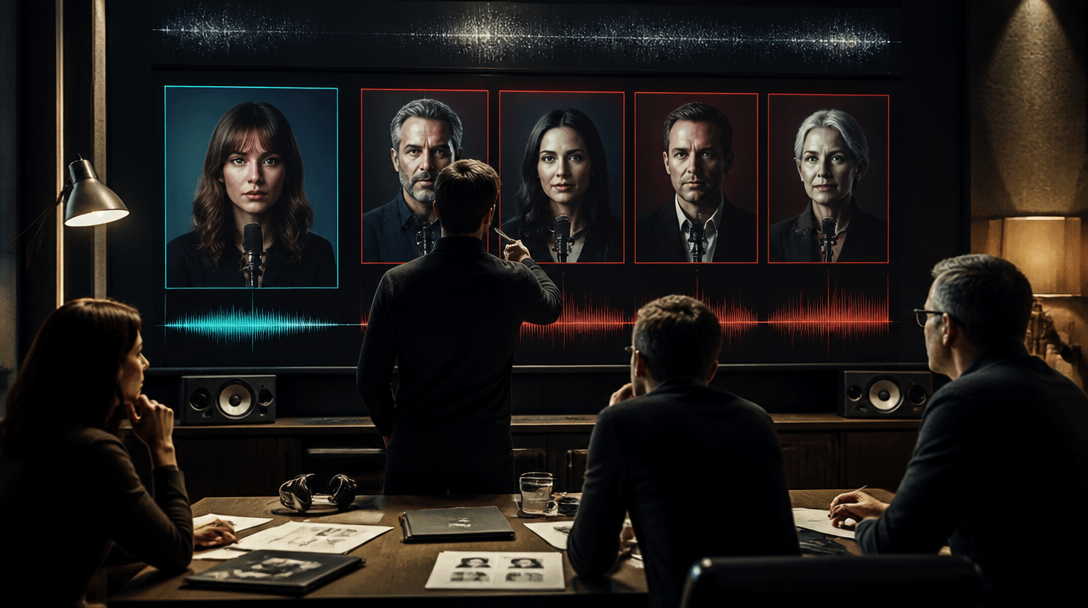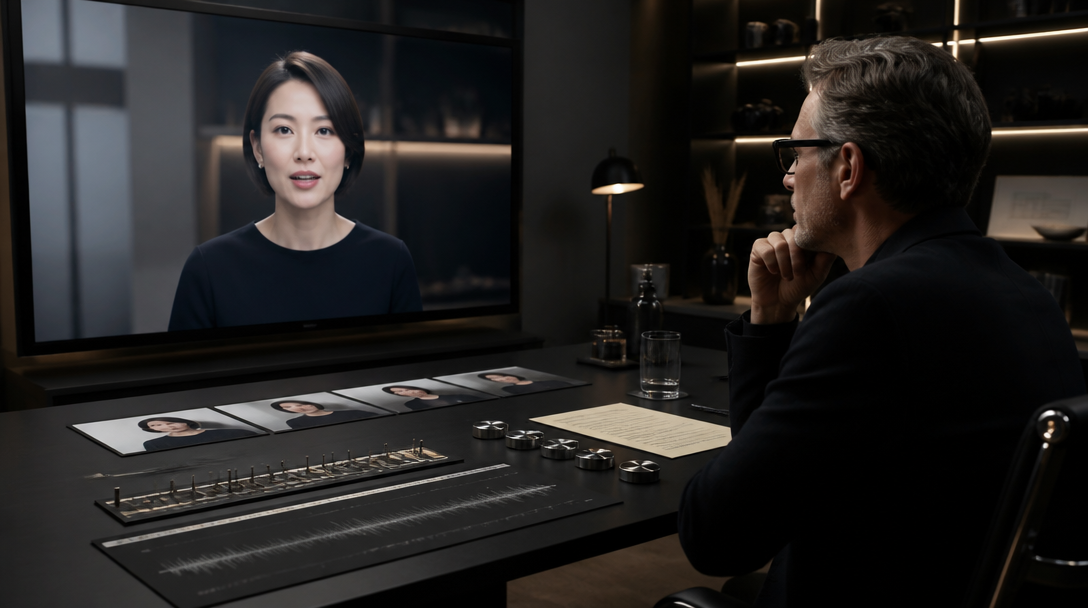
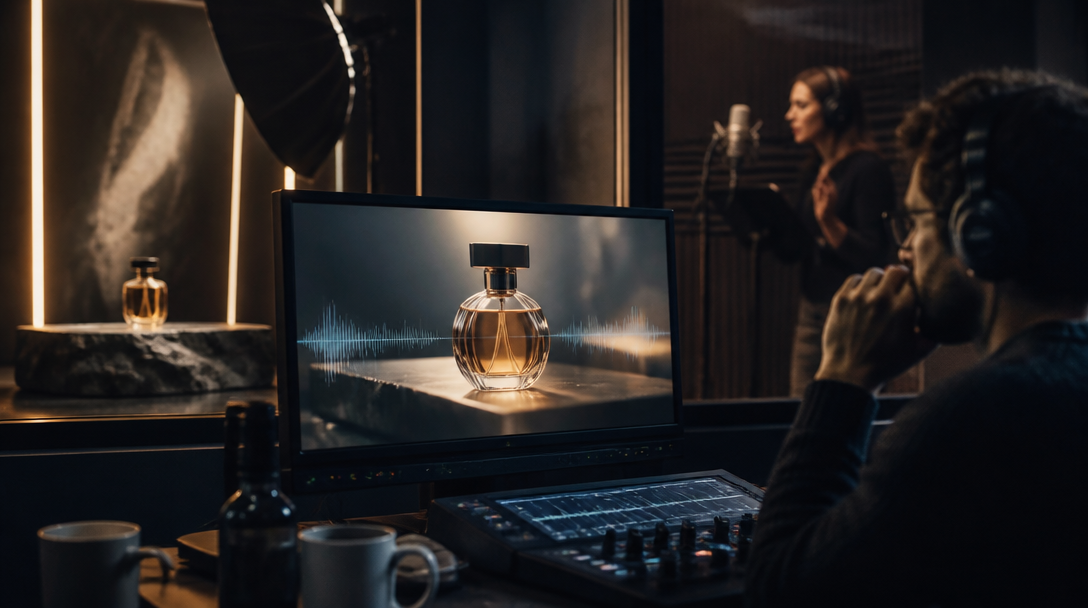
When AI video tools only generated motion, brands could afford to treat sound as a later layer.
That shortcut is weaker now.
Google introduced Veo 3 with native audio on May 20, 2025 and framed it as a model that can generate not only video, but also environmental sound and dialogue. In a later Flow update, Google said you can add speech when using Frames to Video and also said audio generation is still experimental.
That combination matters.
The opportunity is obvious: one tool can now create motion, atmosphere, and a speaking moment in the same pass.
The risk is just as obvious: sound is no longer decoration. It becomes part of the claim, the realism, and the trust signal of the ad.
If the visual is elegant but the voice feels generic, the whole asset gets cheaper.
If the lip sync lands but the line sounds like synthetic ad filler, the frame stops feeling premium.
If the room tone, product action, and spoken promise do not belong to the same world, the viewer notices even if they cannot explain why.
That is why the right first question is not "Can Veo 3 do audio?"
The right first question is "What exact audio job are we asking this shot to carry?"
Native audio changes the review gate
The older review flow for AI video was mostly visual.
Teams looked for drift, product mutation, weird hands, broken reflections, bad motion, or a scene that felt too synthetic.
Native audio adds a second proof layer:
what the scene sounds like,
who appears to be speaking,
whether the spoken line feels written or merely generated,
and whether the sound makes the visual feel more believable or more fake.
For ads, that changes the production job.
A product demo with sound is not just a prettier clip. It is closer to a performance asset. The moment a line is spoken, the brand now owns tone, pacing, implication, emphasis, and review risk.
That means audio should not enter the workflow as a bonus feature.
It should enter as a controlled production decision.
What to test first
Do not start with the hero campaign film.
Start with one six-to-eight-second controlled scene that has a narrow audio job.
The strongest first probe usually has:
one speaker or one implied speaker,
one clear product or offer moment,
one short spoken line,
one simple ambient environment,
and one visual setup the team can already judge without audio.
That structure teaches more than a dramatic multi-shot experiment.
It lets the team isolate whether the sound is helping realism or only creating noise.
The first five things to evaluate
1. What role should the sound play?
Pick one role first:
environmental realism,
product interaction sound,
spoken explanation,
or emotional atmosphere.
Trying to win all four jobs in the first test usually makes the result muddy.
If the ad needs dialogue, let the first test focus on dialogue. If it needs tactile product realism, let the first test focus on sound design around the product.
Sound needs one primary job, just like a frame needs one primary proof task.
2. How short can the spoken line stay?
Shorter is usually better in the first round.
The first useful test is not a monologue. It is one line that the brand could really approve.
Think:
one product truth,
one objection,
one founder-led statement,
or one directionally useful CTA line.
The longer the line, the easier it is for the voice to become generic, overexplained, or rhythmically unnatural.
3. Does the environment match the voice?
This is where many otherwise impressive tests break.
The lip sync can look good while the scene still feels false because the acoustic world makes no sense.
Questions to ask:
Does the voice sound too clean for the room?
Does the room sound too large, too empty, or too cinematic for the frame?
Is the product action supposed to be loud enough to matter?
Is background noise helping realism or masking weak dialogue?
Audio realism is not just about whether a voice exists. It is about whether the whole scene agrees about where the voice lives.
4. Is the spoken line safe for the brand to own?
This is not only a creative question.
Once a model speaks, it can imply confidence, certainty, product performance, or customer experience more strongly than a caption alone.
The brand should check:
whether the line makes a factual claim,
whether the wording overpromises,
whether the speaker sounds like a founder, customer, actor, or narrator,
and whether that implied role is acceptable.
Native dialogue can make a weak claim feel more persuasive than the brand can actually defend.
That is exactly why the line needs approval before scale.
5. Does the sound survive a second listen?
Some AI audio tests win on first novelty and lose on repetition.
The first play feels impressive because the model spoke at all.
The second play reveals the real question:
Would a client approve this tone?
Would a paid ad viewer keep trusting this voice?
Would the line still sound intentional after ten listens in edit review?
If the answer is no, the scene is not ready for production.
What usually breaks first
The failure pattern is already becoming familiar.
The voice sounds more synthetic than the picture
The scene may look premium while the performance sounds like generated filler.
That mismatch is deadly in ads because sound immediately lowers the perceived level of authorship.
The dialogue is too long for the shot
The model has to carry too many words, too much acting intent, and too much timing precision at once.
The result becomes stiff or oddly weightless.
Background sound fights the message
Noise is not realism by itself.
If the atmosphere competes with the line, the viewer works harder to decode the ad and the asset feels less deliberate.
The spoken role is unclear
The viewer cannot tell if they are hearing a founder, a customer, a narrator, or a fictional character.
That ambiguity weakens trust fast.
The team approves novelty instead of repeatability
One cool clip is not yet a system.
If the sound cannot be recreated, refined, or versioned, the asset may be interesting but not commercially useful.
Which controls matter most
Before a team blames the model, it should lock a few production constraints:
exact spoken line,
speaker role,
ambient environment,
shot length,
product truth boundaries,
and rejection rules for tone, clarity, and implication.
Reference lock still matters here.
If the face, product, or scene authority is unstable, the audio test becomes harder to interpret because too many things are moving at once.
That is why the smartest order is:
lock the scene,
define the audio job,
keep the spoken line short,
test one atmosphere range,
reject against a written review checklist.
This is slower than hype.
It is faster than pretending the first talking clip is ready for market.
What Gateway Studio should own
Gateway Studio should not store only the prompt and the exported clip.
It should own the production memory around native audio:
approved spoken lines,
rejected spoken lines and why they failed,
speaker-role logic,
environment notes,
lip-sync issues,
product-truth constraints,
brand-safe claim boundaries,
and which sound direction actually survived review.
That memory matters because audio introduces a new kind of drift.
The drift is not only visual anymore.
It is tonal.
One version sounds too polished. Another sounds too robotic. Another sounds too dramatic for the brand. Another sounds believable but says the wrong thing.
Without structured memory, teams repeat those mistakes with slightly different prompts and call it experimentation.
With structured memory, the workflow compounds.
The practical rule
Treat Veo 3 native audio like a production layer, not a magic trick.
The first test should be small, controlled, and easy to reject.
One short line.
One clear speaker role.
One believable room.
One visual setup that already works without audio.
If that passes, then scale to more expressive scenes.
If it fails, do not hide the failure inside prompt enthusiasm.
Rewrite the audio job, tighten the line, and protect the brand world before the next render.
That is the premium move.
Not more noise.
More control.
Test one six-to-eight-second scene with one clear speaker role, one short approved line, and one simple environment. The goal is not spectacle. The goal is to isolate whether the sound makes the ad more believable or just more complicated.
Next move