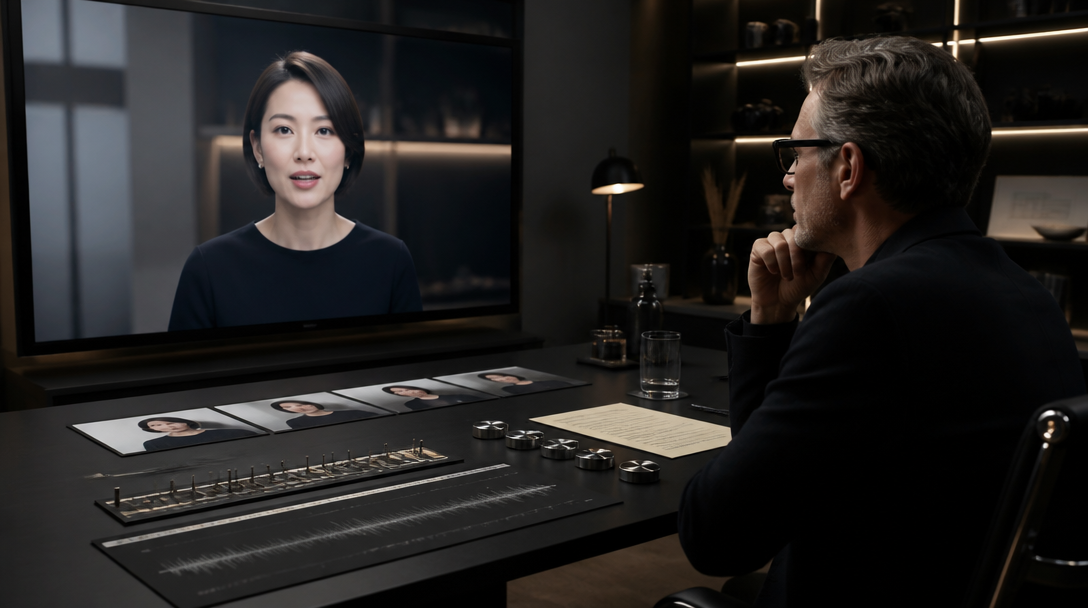
The first close-up wins the room.
The founder looks composed. The customer sounds believable. The lighting feels expensive. The AI voice even lands better than expected.
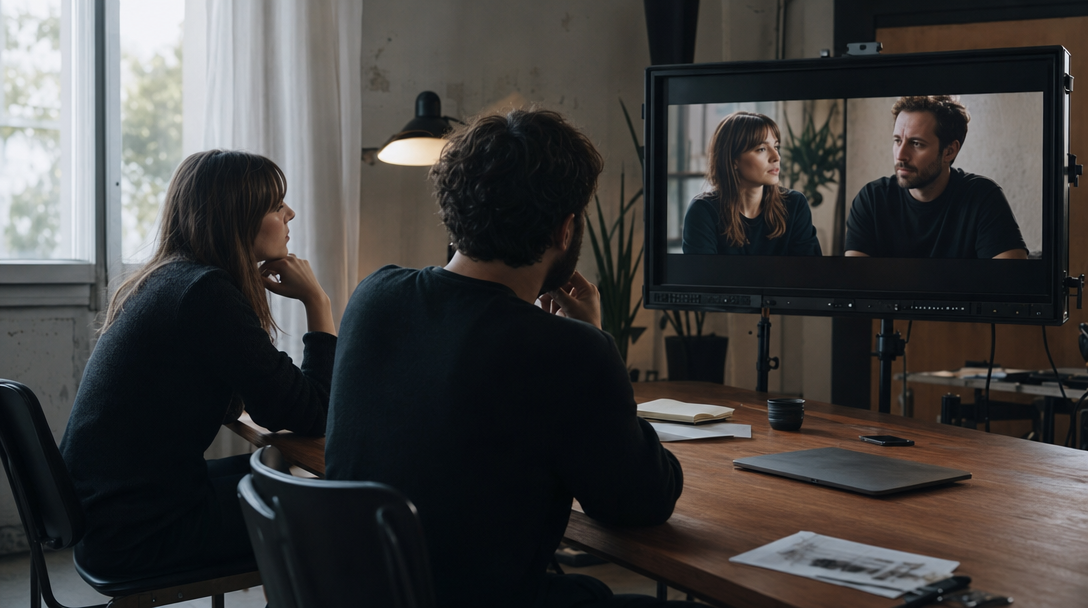
Then the reverse shot appears and the whole scene quietly stops being true.
The founder is looking slightly past the other person.
The customer answers from a different height than the frame before.
The over-shoulder shot suggests a new room geometry that never existed in the wide.
Nothing is obviously broken in isolation.
The scene still feels polished shot by shot.
It just no longer feels like two people sharing one moment.
That is where a surprising amount of AI dialogue work fails.
Not in the line reading.
Not in the voice model.
In the invisible spatial logic between cuts.
The cut is where the lie finally becomes visible
Single-shot AI scenes can survive a lot.
A close-up can carry mood, confidence, and even a decent performance pass before anyone asks harder questions about the space around it.
Dialogue scenes do not get that luxury.
The moment the viewer sees person A, then person B, then the return cut, the brain starts checking whether the scene still obeys one shared geography.
It reads:
where each person is seated,
how high each eye line sits,
whether the speaking rhythm fits the framing distance,
which shoulder belongs to which side of the room,
whether the camera crossed an invisible axis,
and whether the emotional power of the scene was earned by blocking or only faked by coverage.
Take a founder interview ad for a premium skincare launch.
The first frame is a beautiful medium close-up. Calm side light. Controlled wardrobe. The founder explains why the product texture matters.
Then the customer reaction shot lands.
If that second frame makes the customer look like they are speaking to someone above the founder, or across a wider room than the wide shot implied, the scene loses authority immediately. The words may still be right. The room no longer agrees with them.
That is not a film-school nitpick.
It is a trust problem.
Dialogue is not mainly a script problem
Teams often treat AI dialogue scenes as a writing problem first.
They polish the line. Tighten the hook. Swap the voice. Shorten the answer. Add a better emotional beat.
All of that matters.
But once the format depends on alternating coverage, dialogue becomes a spatial system before it becomes a performance system.
The scene has to decide:
who owns camera-left and camera-right,
where the shared eye line sits,
how far apart the speakers are allowed to feel,
how the camera may advance without collapsing the axis,
whether the room belongs to a founder conversation, a review table, a creator setup, or a polished testimonial environment,
and what physical details must inherit unchanged across the shot family.
Example: a two-person creator explainer for a software tool may feel best when the host sits slightly closer to lens and the guest answers on a modest off-axis eyeline. That choice affects everything else: desk depth, monitor glow, shoulder framing, microphone position, and how aggressive the reverse cut is allowed to be.
If those rules are not locked, the model improvises the missing geography for each shot independently.
That usually produces attractive fragments, not a believable scene.
Start with an eyeline map, not a dialogue pass
The useful first artifact for a multi-person AI scene is often not a script page.
It is an eyeline map.
That map should define:
speaker positions in the room,
the working axis of the scene,
approved lens families for wide, medium, and reverse shots,
the vertical eye-height band for each speaker,
how close each person is allowed to feel to lens,
whether the listener is present as shoulder, profile edge, or implied offscreen partner,
and which cut may break symmetry without breaking trust.
This sounds technical because it is.
It is also practical.
Imagine a premium product interview with a founder and a design lead at one long oak table.
The founder owns camera-left in a 50mm medium close-up.
The design lead answers from camera-right on a slightly tighter lens.
The listening shoulder only appears in one shot family, never both.
The room keeps the same window direction, same chair height, same distance to the table edge, and the same warm-but-controlled atmosphere.
Once that map exists, the script has a room to live in.
Without it, every new pass risks inventing a fresh scene.
The first test should be a proof loop of three cuts
Do not start by generating the full dialogue sequence.
Start with the shortest loop that can expose whether the scene understands itself.
The best first test is usually:
one speaker close-up,
one reverse on the second speaker,
one return cut that proves the first frame still belongs to the same room.
That loop tells you almost everything you need to know:
did the axis hold,
did the speakers stay at believable relative height,
did the room depth survive,
did wardrobe and facial identity stay stable enough,
did the listening energy feel continuous,
and did the reverse cut make the scene stronger instead of merely more expensive-looking.
For a podcast-style ad, that loop may include visible microphones and headphones because those props anchor the room truth.
For a founder-customer conversation, it may be cleaner to avoid props and let chair height, shoulder angle, and table distance carry the continuity.
For a creator testimonial hybrid, the first loop may need one more boundary: the creator can speak to lens in the opening, but the moment the conversation switches to a partner frame the eye line cannot pretend to be direct address anymore.
If the three-cut loop does not hold, a longer sequence will only hide the failure under more motion and music.
Which settings and constraints matter most in AI dialogue scenes
Different tools expose different controls, but the same pressure points keep showing up in multi-person scenes.
Reference hierarchy
One image should own room geometry.
Another may own wardrobe and face identity.
A third may own atmosphere.
Do not give all references equal authority. When the room reference loses rank, the scene usually starts cheating between cuts.
Lens discipline
Dialogue scenes get fake fast when the coverage jumps between incompatible lens feels. Pick a narrow family and keep it there. A founder close-up that feels like a calm 50mm should not suddenly reverse into a distorted wide that belongs to a music-video insert.
Camera-height band
This is one of the cheapest fixes and one of the most ignored. If the first speaker sits at a grounded seated eye level, the reverse cannot float half a head higher without changing the emotional relationship in the scene.
Listener persistence
Decide whether the offscreen partner exists only through gaze, through a shoulder edge, or through partial profile. If that rule changes every cut, the room stops feeling inhabited.
Speech-pressure ceiling
Some AI dialogue shots fall apart because the team asks for too much performance before continuity is stable. Test the calm version first. Once the scene survives quieter delivery, then push pace, overlap, or emotional emphasis.
Failure criteria
Write them down before review:
no eye-line jump that changes who is above or below whom,
no reverse shot that implies a different table depth,
no listening shot that turns into a second hero portrait,
no pretty bokeh that erases room logic,
no cut that makes the speakers feel like they were filmed on different days in different spaces.
That list protects the room from approving a frame just because one face happened to look great.
What breaks most often
The repeat offenders are surprisingly consistent.
The reverse shot becomes a new world
The close-up holds. The reverse invents a different chair height, a different table, or a different window direction. The team notices only that it "feels a bit off."
Both people get hero treatment
Every shot tries to be the prettiest shot. Nobody stays in the more functional listening role, so the conversation stops feeling reciprocal and starts feeling assembled.
Direct address leaks into partner coverage
A creator can open to lens and still transition into dialogue, but only if the handoff is governed. If every cut feels half-direct and half-conversational, the viewer cannot tell whether the scene is confession, interview, or ad copy recital.
The wide shot cannot defend the close-ups
When the room finally opens up, the table, chairs, door line, or human spacing contradict the intimacy the close-ups promised.
Teams chase emotion before they lock geography
They ask for stronger pauses, more chemistry, or more energy when the real issue is that the spatial relationship between the people never stabilized in the first place.
What Gateway Studio should remember after review
Dialogue scenes get expensive when every new round starts from taste and hope.
Gateway Studio should keep:
the eyeline map for the scene family,
approved axis notes,
lens and camera-height lanes,
which speaker owned which side of frame,
the strongest three-cut proof loop,
rejected reverses and the exact spatial lie they introduced,
the props or shoulders that helped the scene feel shared,
whether the format was safer as founder interview, creator explainer, testimonial pair, or direct-to-lens monologue,
and the point where a real set, partial reshoot, or hybrid plate became the smarter move.
Picture a campaign where the founder introduces a product, a customer answers one practical objection, and the brand needs cutdowns for paid social, the landing page, and a retargeting sequence.
If the approved conversation logic lives in Gateway Studio, the next round does not ask the model to reinvent chemistry.
It asks for one governed variation inside a room that already proved it can survive the cut.
That is the difference between an AI dialogue scene that feels directed and one that feels assembled from nice mistakes.
Closing thought
Most teams blame AI dialogue scenes when the face drifts or the voice sounds synthetic.
Those are real problems.
But a lot of scenes fail earlier than that.
They fail in the silent space between one person looking and the other person answering.
When the eyelines hold, the conversation starts feeling shared.
When they do not, even a beautiful performance sounds like it happened alone.
It is the control layer behind the scene: who owns camera-left and camera-right, where the working axis sits, how high each speaker may read, which lens families are approved, and how the reverse shot is allowed to inherit the same room.
Next move