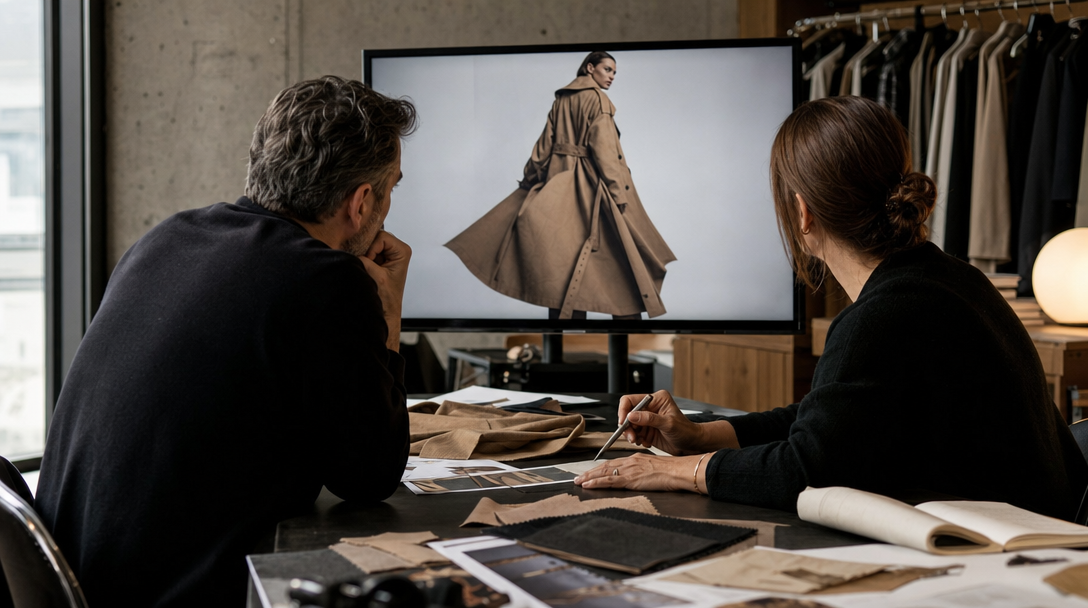
The first frame is beautiful.
Hard side light. Clean cheekbone. One expensive coat. Polished concrete floor.
Everyone in the room relaxes because the reel finally looks like the brand they wanted.
Then the model turns.
The hem lifts too quickly. The sleeve snaps back like thin paper. The belt loses weight between cuts. A satin skirt that felt rich in the still suddenly moves like laminated ribbon.
That is where a lot of AI fashion motion really breaks. Not at the face. Not at the set. Not even in the first frame. It breaks when fabric stops negotiating with gravity.
Apparel buyers read that faster than most teams expect. They may not say, "the drape inertia is wrong." They say the piece feels cheap, costume-like, overstyled, or not worth the price. The language sounds casual. The damage is commercial.
Gateway's view is simple: if a fashion brand uses AI for reels, launch films, or paid cutdowns, the garment cannot be treated like prop styling. It is the product. That means fabric weight, seam tension, hem return, and body-to-garment contact need their own review system before the campaign branches into more versions.
In fashion motion, fabric becomes the truth surface
A still image can hide a surprising amount.
A wool coat can look authoritative in one planted pose even if the side seam has already softened. A pleated skirt can read premium in a front-facing hero while the back pleats would collapse the second the model walks. A bomber jacket may feel strong in a waist-up crop while the waistband would start floating the moment the talent lifts an arm.
Video removes that protection. Movement asks the garment to explain itself.
Take three common examples:
A trench launch reel opens on a slow pivot. The collar is sharp, the belt knot is good, the lighting is expensive. But when the model turns out of profile, the hem swings with no delay and the back vent stops reading like a structured cut.
A beauty-fashion crossover ad uses a satin slip dress in a mirror setup. The first frame sells atmosphere. Two seconds later, the highlights stop following the folds and the dress behaves like coated paper.
A streetwear drop teaser uses a heavyweight hoodie. The silhouette looks great until the hands go into the pocket and the kangaroo pocket no longer carries the same mass as the torso.
Those are not styling notes. They are trust notes.
If the frame is asking the viewer to believe the garment is premium, then fabric behavior is part of the claim.
Build a gravity card before you build shot lists
Most teams make a moodboard. That is fine for tone. It is weak for motion.
For apparel motion, the more useful control object is a gravity card. Think of it as the movement equivalent of a fit pack.
A gravity card should say:
what the garment weighs visually,
where stiffness is allowed and where it would be suspicious,
how quickly the hem is allowed to recover after a turn,
which seams must stay legible,
what kind of body contact is safe,
which movement family the piece can survive without inventing a different cut,
and which close-ups still need real capture.
Example: for a tailored blazer, the card should cover shoulder shape, lapel roll, sleeve break, button stance, hem return, and how the jacket behaves when the wearer sits, reaches, or closes one side with a hand.
For a fluid dress, the card changes completely. Now you care about drag, cling, fold memory, strap tension, and what happens when the body rotates faster than the fabric can follow.
For wide-leg trousers, the card may focus on front crease survival, hem pooling, knee break, and whether the fabric separates naturally between steps.
That card gives the room a much better question than "Does this feel elevated?" The better question is "Does this movement still belong to this garment?"
Stop asking one reel to do both persuasion and proof
Fashion teams get into trouble when the same clip is expected to close every job.
It cannot.
Editorial motion
This is the lane where you can sell mood. You can shoot tighter. You can let hair, light, and composition do more work. You can use one walk-by, one turn, one hand detail, one close crop of collar or fabric shine.
Example: a fragrance-adjacent fashion teaser for a fall coat can live on atmosphere. The viewer only needs the garment to feel believable enough to support the brand world. The reel does not need to prove full fit logic at every second.
Fit-adjacent motion
This is stricter. The moment the reel is meant to support a PDP, a drop page, a sizing question, or a high-intent click, movement has to protect product truth.
Example: if the paid cut is driving to a dress PDP, the clip cannot quietly improve the waist position, erase side volume, or shorten the hem through crop choices and motion cleanup. The buyer will meet the real product one tap later.
Hybrid motion
This is often the smartest lane. Use AI to establish tone, rhythm, or scene family. Use real capture for the shot where the garment must defend itself literally.
Example: a jacket campaign may keep the AI opener, the editorial side profile, and the moody hallway walk. But it may switch to real capture for the zipper close, the seated posture, and the front-on walk where the buyer reads structure and length.
That split saves money more often than trying to force every motion beat through one synthetic workflow.
Four reviews that catch fake drape early
Do not review apparel motion as one big taste conversation. Break it into four fast passes.
1. The turn test
Take one approved look and compare:
a still authority frame,
a quarter turn,
a full turn exit.
Watch the hem lag, belt delay, sleeve recoil, and whether the garment keeps the same center of weight.
A coat can look luxurious head-on and become costume material the moment it exits the light.
2. The stride test
Run one controlled walk cycle. Not a dramatic catwalk. Not wind. Just a natural stride.
Look at:
inner leg separation,
hem swing,
crease survival,
and whether the garment keeps one believable pattern from left step to right step.
This is where wide-leg trousers, midi skirts, and soft tailoring often get exposed.
3. The contact test
Add one real-world contact point:
hand in pocket,
hand on hip,
bag strap across shoulder,
seated edge,
arm crossing the torso.
This tells you whether the garment responds like cloth around a body or like surface decoration pasted onto one.
A cashmere cardigan may survive a gentle arm fold. A structured corset top may not survive a casual twist without inventing new tension lines.
4. The crop inheritance test
Now export three versions from the same direction:
website hero,
4:5 paid crop,
9:16 short-form crop.
Check whether the crop hid the exact evidence that kept the garment honest.
A fashion team may accidentally approve a beautiful waist-up paid crop because it removed the hem behavior that was already starting to fail.
That is not a better asset. It is a delayed complaint.
Where AI fashion motion is genuinely useful
There is a lot of good territory here when the brand respects the boundary.
AI apparel motion is useful for:
early scene-direction tests before a physical fashion shoot,
seasonal paid variants around an already approved garment truth,
short editorial loops for launch pages and social cutdowns,
art-direction exploration around one silhouette family,
multi-format crops once the product behavior is already understood,
and previsualization for how one garment world might expand into campaign motion.
Example: an outerwear brand already owns clean PDP stills and one real fit video. AI can help build colder, moodier paid variants around that truth without asking the system to invent how the coat hangs from scratch.
A knitwear label may use AI to test three lighting worlds, two room temperatures, and several editorial pacing options before deciding what deserves a real studio day.
That is good use. The garment truth already exists. AI is extending the campaign around it.
When real capture is still the cheaper decision
Sometimes the most expensive thing on set is false confidence.
Real capture is usually the smarter line when the reel depends on:
technical fit,
support or compression perception,
transparent or layered fabric,
precise tailoring,
luxury price justification through material behavior,
or a motion beat that will drive sizing or quality questions.
Think of suiting, bridal, lingerie, performancewear, occasion dresses, or anything where the shopper is buying not only the silhouette but the promise of how the piece lives on a body.
The same applies when comments or customer support will likely turn one pretty reel into practical fit questions. If the audience is going to ask about length, lining, structure, coverage, or stiffness, the proof lane should arrive before the ad scales.
Gateway's rule here is blunt: if the garment is doing the selling, do not let synthetic motion become the only witness.
What Gateway Studio should remember after the review room moves on
The renders are not the system. The memory around them is.
For apparel motion, Gateway Studio should keep:
the gravity card for each garment family,
authority stills and real motion references,
approved movement lanes,
banned drift patterns,
crop approvals by placement,
the specific shots that stayed editorial,
the specific shots that crossed into proof,
and the reason a hybrid switch happened.
Example: if three versions of the same skirt fail because the back pleats flatten during the turn, that should become named memory. The next brief should not rediscover it from scratch with a new prompt and better music.
That is where a production workspace earns its keep. It stops the team from paying twice for the same lesson.
The hard part is not making fashion look beautiful
The hard part is making beauty survive scrutiny.
AI can already give a fashion team a lovely first frame. That is not the milestone. The milestone is whether the garment still looks like itself once it walks, folds, catches light, takes weight, and returns from motion.
If the cloth forgets gravity, the ad starts borrowing credibility from a product the viewer has not met yet. That is a fragile way to sell anything premium.
The stronger workflow is calmer than most teams expect. Lock the garment truth. Build the gravity card. Split editorial motion from proof motion. Run the four reviews. Keep the failed drifts in memory. Then let the campaign grow.
That is how AI fashion motion becomes a useful production tool instead of a beautiful way to fake drape.
Because apparel trust gets audited in motion. A still can hide fake drape, but turns, stride, and body contact quickly reveal whether the fabric keeps the same weight, seam logic, and garment identity.
Next move