At the first review, nobody complains about the hero frame.
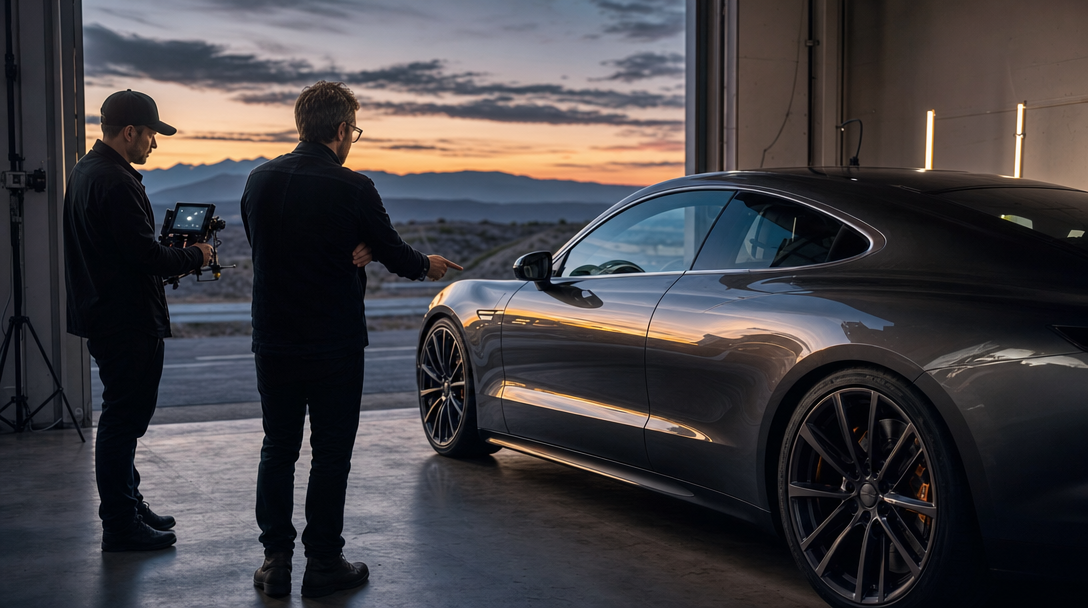
The graphite coupe is sitting low. The shoulder line is clean. The paint has that expensive depth brands chase when they want an automotive launch to feel premium instead of synthetic.
Then the side tracking shot starts.
The horizon bends across the door as if the body panel were softer than stamped metal. The reflection on the rear quarter no longer belongs to the same street. The wheel face changes just enough that the brake hardware feels borrowed from another car.
Nothing looks absurd. That is exactly why the problem survives too long.
Automotive viewers read surface logic faster than many teams admit. They may never say, "the reflection family drifted between shots." They simply stop trusting the car.
Gateway's view is blunt: in AI car ads, reflections are not decoration. They are one of the main proof surfaces. If paint, glass, chrome, and wheel behavior do not stay continuous, the film stops feeling engineered and starts feeling improvised.
In automotive work, reflections carry the engineering story
People do not watch a car the way they watch a soft lifestyle object.
They read:
whether the body lines hold under changing light,
whether the panel transitions still belong to the same shell,
whether the windshield and side glass behave like real glass instead of dark screens,
whether chrome trim keeps one believable highlight logic,
and whether the environment reflected in the paint belongs to the road, studio, or tunnel the car is supposedly moving through.
That is why a car ad can fail while still looking glossy.
Take a dark electric sedan on a dawn road. The first frame looks perfect: long highlight, clean hood, expensive color grade, quiet sense of speed. Then the car passes a concrete barrier and the reflection on the front door starts acting like mirrored liquid instead of painted metal. The viewer may not know why the frame weakens. They only feel the body stopped being a real object.
Or take a studio launch film for a performance SUV. One angle makes the paint feel deep and controlled. The next angle brightens the roofline, but the greenhouse suddenly reflects a completely different room. Now the car is no longer one physical object under one lighting plan. It is two attractive guesses cut together.
That is the trap. Automotive beauty often hides its own evidence.
A still can pass. A rolling shot asks harder questions.
A static hero image can forgive more drift.
It can hide:
a wheel design that would collapse in motion,
panel reflections that only work from one side,
glass that looks convincing until the camera changes height,
or a metallic paint finish that stops behaving like the same material once the car turns.
The moment the camera moves, the ad has to answer different questions.
Does the beltline stay stable while the environment slides over it? Do the wheel spokes and brake hardware still belong together on frame eight, not only frame one? Does the windshield reflect something physically plausible, or just something dramatic? Does the side mirror hold its geometry when the shot compresses?
That is why AI Product Motion Needs a Material Truth Sheet Before Animation Starts matters even more in automotive work. Cars combine paint, glass, chrome, rubber, light signatures, and moving geometry in one object. If the workflow protects only the silhouette and not the surface behavior, the first moving shot exposes the whole weakness.
Build a reflection continuity board before the first driving pass
Most teams already make moodboards. That is not enough here.
What automotive work needs is a reflection continuity board: one control layer that defines what the car is allowed to reflect, how those reflections travel, and which surfaces carry literal trust.
The board should lock five things before the first batch gets larger.
1. Environment family
Pick one environment logic for the scene.
Is the car moving through:
a restrained daylight road,
a clean studio with long controlled strip reflections,
a wet night street,
or a tunnel with repeatable rhythm?
Do not mix all four because they each make the paint tell a different story.
Example: if the launch film uses a satin graphite coupe on a mountain road at blue hour, the side panels should keep long horizon-led reflections with occasional guardrail interruptions. They should not suddenly start reflecting tall urban glass facades halfway through the sequence just because that image looks dramatic on its own.
2. Panel-truth zones
Mark the surfaces where drift is unacceptable.
For most automotive scenes, that includes:
hood shoulder lines,
front door and rear door transition,
rear quarter flare,
window belt trim,
mirror housing,
and the relationship between wheel arch and tire.
These are the places where a car stops feeling manufactured if the reflection bends the wrong way.
Example: in a low side track on a silver hatchback, the strongest review question is not "does this look cinematic?" It is "does the reflection travel across the front and rear door like one stamped body family, or does it make the cut line feel rubbery?"
3. Glass logic
Car glass should not behave like generic dark transparent material.
You need rules for:
how much cabin detail is allowed,
when the windshield may go darker,
whether the side glass is reading sky, architecture, or interior,
and when reflections should dominate over the cabin versus reveal it.
Example: an interior-to-exterior crossover shot for an EV can look premium when the driver-side glass carries a clean skyline reflection while the dashboard stays subdued. If the same shot suddenly reveals an unrelated steering-wheel shape or impossible seat geometry through the glass, the reflection becomes a lie instead of an enhancement.
4. Wheel and speed truth
Automotive AI often gets the body closer than the rolling hardware.
Lock:
which wheel design is the authority,
how much rotational blur is believable,
whether the brake caliper is visible in the chosen speed range,
and what tire sidewall behavior is safe.
Example: for a low-speed launch pass, you may still want readable wheel identity and only modest blur. If the wheel center changes design between three-quarter and side pass, the viewer reads not speed, but inconsistency.
5. Beauty versus proof split
Not every shot should carry the same burden.
Some automotive frames are allowed to sell mood. Others must survive scrutiny.
Separate them early.
A silhouette reveal in rain can be atmosphere-heavy. A side panel tracking shot on a hero colorway is proof-heavy. A macro close-up of the headlight signature sits somewhere between them.
That split gives the team permission to be expressive without letting every frame pretend to be literal evidence.
Test three shots before you build the whole film
Do not start with the full hero edit.
Run three shots first.
Shot one: parked three-quarter hero
This tells you whether the stance, wheel fitment, and paint depth are even worth protecting.
If the car already feels flimsy here, motion will not save it.
Shot two: slow side tracking pass
This is the real truth test.
You are watching:
reflection travel,
panel transitions,
door cut consistency,
wheel identity,
and how the road or studio environment stays attached to the body.
If this shot fails, stop expanding the batch. Do not hide the problem inside more edits.
Shot three: windshield or side-glass crossover
This tells you whether the car can survive a premium film language instead of only a static launch still.
The question is not whether the glass looks dramatic. It is whether exterior reflection, interior visibility, and body geometry still belong to one believable car.
That test is the automotive cousin of Product Video Ads From Images: What to Test First and What Must Not Drift. The first few shots should narrow uncertainty, not multiply it.
When hybrid or real capture is still the smarter call
Some automotive moments still deserve reality, or at least a hybrid path.
That usually includes:
legal or retail surfaces where trim, badging, or exact option pack matters,
headlight and taillight behavior that buyers know too well to forgive,
interior hands-on moments with safety-critical screens or controls,
rain, dirt, or road spray behaving close to the body,
and situations where one exact model-year detail carries real buyer trust.
This is the same logic behind Why Product Realism Is a Business Trust Issue. If the frame is carrying a fact the audience already knows how to inspect, visual style alone is not enough.
Gateway Studio should own that split. Not as a late rescue. As an early production decision.
What Gateway Studio should remember after the review
The value is not only one approved cut.
The value is the memory the next round inherits.
For automotive work, Gateway Studio should keep:
the authority still for the approved model and trim,
the reflection continuity board,
the accepted environment family,
wheel and brake visibility rules by shot speed,
safe glass behavior notes,
rejected tracking frames with reasons,
the line between atmosphere-heavy and proof-heavy surfaces,
and the point where the workflow switched from AI-only to hybrid or real capture.
That memory is what keeps the next launch from relearning the same expensive lesson.
Because the real failure in AI car ads is rarely that one frame looked synthetic. It is that the team approved a beautiful surface before it proved it could stay true while moving.
It is the control layer behind the render: approved environment family, panel-truth zones, glass rules, wheel and speed rules, and the split between atmosphere-heavy shots and proof-heavy automotive shots.
Next move