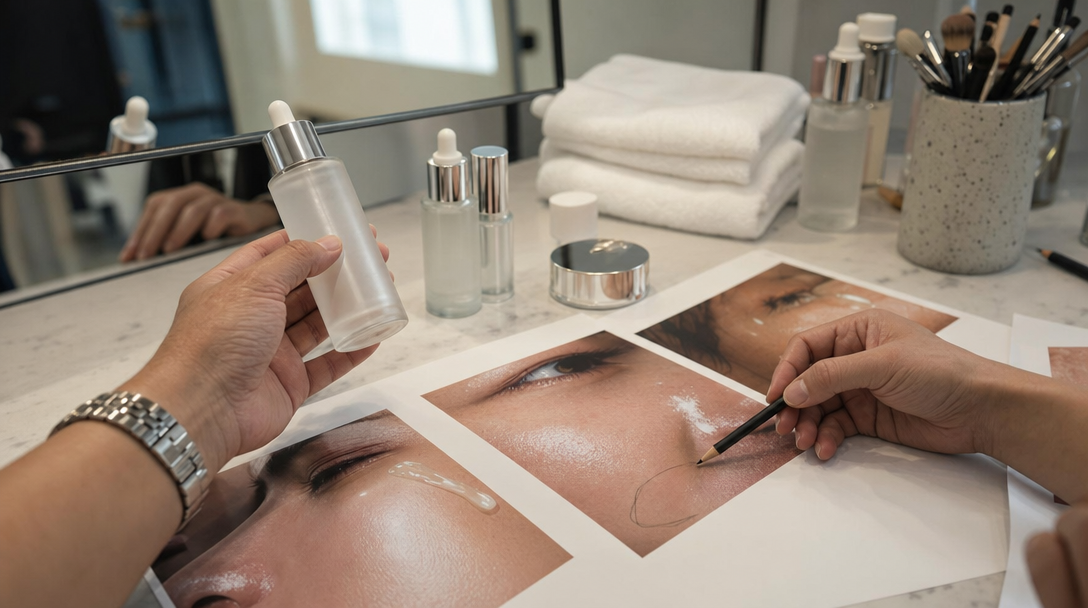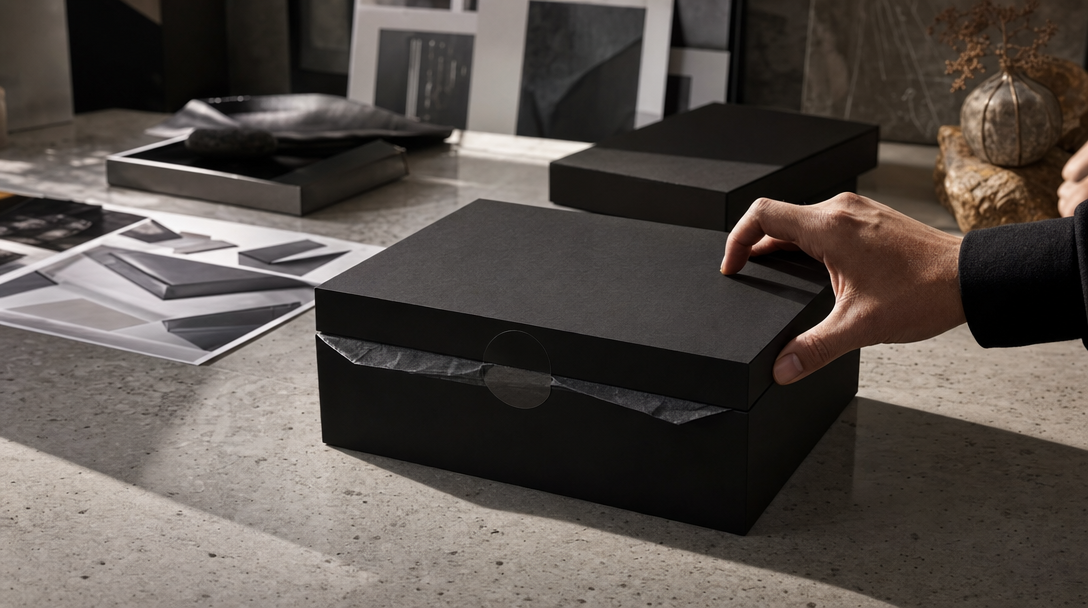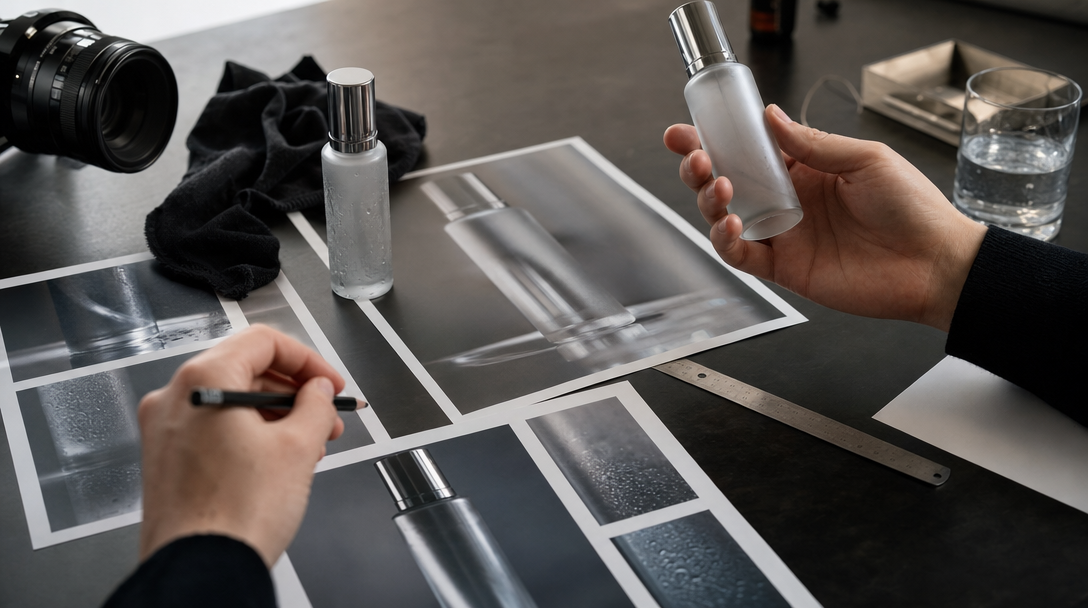
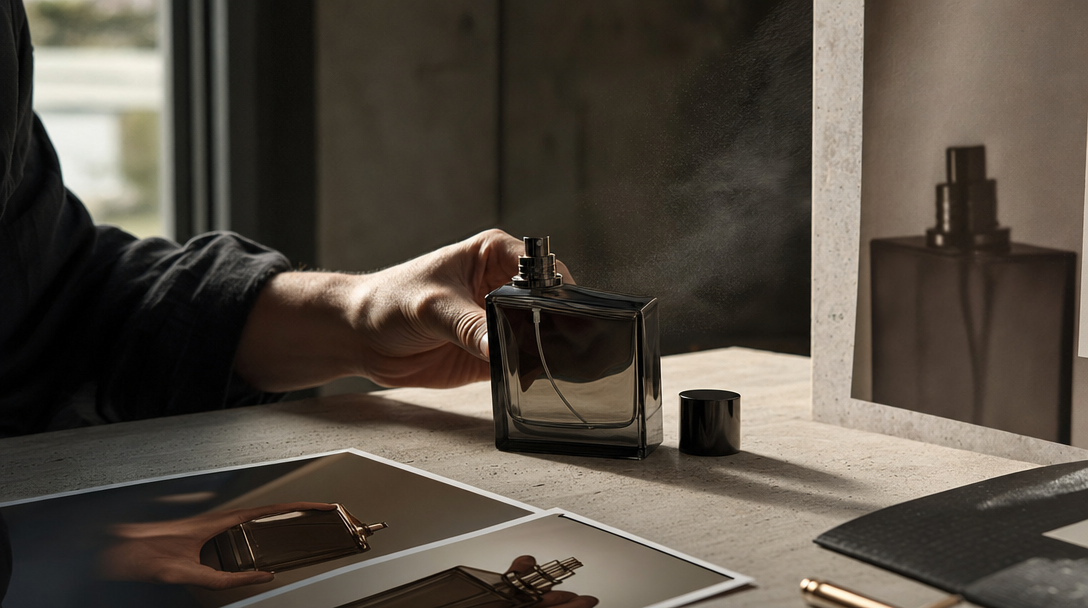
A perfume campaign can look approved long before it is coherent.
The bottle still is elegant. The cap-off close-up feels sensual. The wrist mist looks expensive. The room shot has atmosphere.
Then the editor runs the sequence and the whole thing starts feeling invented.
Maybe the bottle is a sharp black extrait on dark stone, but the skin shot suddenly belongs to a soft peach beauty world. Maybe the atomizer throws a cloud wider than the nozzle could ever push. Maybe the final room image says smoky hotel bar while the bottle styling was selling clean morning citrus. Nobody in the meeting says "your scent proxies no longer agree."
They say something simpler: it does not feel like the same perfume anymore.
Fragrance work is unusually demanding because the product itself is invisible. The campaign sells an invisible thing through a chain of visible clues: glass weight, cap fit, finger pressure, mist behavior, skin distance, fabric response, and the room the scent seems to inhabit. When those clues stop telling one story, the ad loses authority even if each frame still looks beautiful on its own.
Gateway's view is practical: fragrance campaigns should be built as a scent-transfer shot family, not as one hero bottle still plus improvised extras.
Perfume is bought through transfer, not only through the bottle
A luxury handbag can borrow trust from leather and hardware. A watch can borrow it from macro geometry. A fragrance has to borrow it from transition.
The buyer is reading whether the world around the perfume makes sense:
does the bottle feel heavy enough for the price point,
does the cap come off like a real object with fit and resistance,
does the mist leave the nozzle with believable direction and density,
does the skin or fabric react like a surface that could really hold scent,
and does the final environment still belong to the same olfactive story?
That last point is where teams get sloppy.
They treat the room shot like decoration. It is not decoration. It tells the viewer what kind of presence the scent leaves behind.
Take three common launches:
A dark cherry and incense extrait is styled on polished stone, then the body shot jumps into bright bathroom daylight and the scent suddenly feels lighter and cheaper than the bottle promised.
A citrus floral campaign uses an airy mist around bare shoulders, then the final room shot goes heavy on amber shadows and velvet, so the brand no longer knows whether it is selling freshness or evening drama.
A premium niche perfume looks beautiful on table, but the atomizer close-up sends out a theatrical fog cloud that behaves like stage smoke instead of perfume, and the whole launch starts reading like fantasy styling rather than an object someone could own.
Fragrance buyers do not need perfumery vocabulary to feel this break. They just feel that the ad is borrowing signals from several different scents at once.
Give the shot family four jobs before you generate anything
The cleanest fragrance work usually separates four jobs.
1. Bottle authority shot
This shot answers one question: what is the object we are trusting?
It locks the bottle family, the glass thickness, the shoulder shape, the cap finish, the metal or lacquer behavior, and the exact level of polish the launch is claiming.
For a luxury black-glass extrait, the authority shot might be a weighted bottle on honed travertine with one cool side light and a deep falloff behind it. The point is not to make the bottle mysterious. The point is to make it feel exact.
If the authority shot is vague, every later shot starts improvising the object.
That is the same commercial trap we see in AI Product Motion Needs a Material Truth Sheet Before Animation. A bottle that looks premium from the front and unstable from the side is not a stronger asset. It is a prettier argument for confusion.
2. Cap-off or atomizer-prep shot
This shot answers a different question: how does the object begin to open or act?
Here the viewer reads fit, friction, finger pressure, the gap between cap and collar, and whether the sprayer looks like a real mechanism or a decorative guess.
One concrete example: an editorial launch cut shows a thumb lifting a matte metal cap from a square bottle. If the cap leaves too much empty space, if the fingers do not compress naturally, or if the cap seems lighter than the bottle body, the whole perfume starts feeling like a prop.
This is why fragrance cannot be treated like generic beauty atmosphere. The first gesture is already part of product truth.
3. Skin or fabric contact shot
This shot answers: where does the scent live once it leaves the bottle?
Sometimes that is wrist skin. Sometimes collarbone. Sometimes the lapel of a wool coat, a silk scarf, or a cotton shirt opening.
The job is not to create random sensuality. The job is to prove scale, distance, and contact.
For a day fragrance, a believable wrist mist might show a controlled plume traveling a short distance in morning light with visible finger pressure and skin texture. For an evening scent, the stronger visual might be a silk collar receiving a tighter mist path in lower directional light. Both can be beautiful. Both fail if the cloud is too large, too decorative, or too disconnected from the bottle mechanics that supposedly created it.
If your team already struggles with body-contact realism, the same discipline behind AI Skincare Ads Need Application Truth Before the First Close-Up applies here too: once a surface becomes evidence, stylization has a ceiling.
4. Room residue shot
This shot answers: what world does the scent leave behind?
It might be a marble vanity after application. It might be a quiet hotel corridor, a dressing room mirror, a restaurant table after the hand leaves frame, or a tailored coat resting in warm evening air.
The mistake is asking this shot to replace the bottle shot.
Room residue is not where the campaign explains packaging truth. It is where the campaign extends the emotional radius of the scent after the product and body logic are already stable.
When teams skip that order, the room starts selling a different perfume than the bottle ever did.
The sequence usually breaks when one shot is forced to do two jobs
Fragrance campaigns get messy because the team keeps overloading the same frame.
The bottle shot is asked to prove glass detail, lifestyle mood, and social-thumb performance all at once. The mist shot is asked to prove spray mechanics and also act like abstract luxury atmosphere. The room shot is asked to rescue a product identity that was never stabilized earlier.
That overloading creates three expensive failure patterns.
First, the bottle keeps changing category family. A clean transparent citrus bottle becomes moodier and darker in the social cut, then warmer and heavier in the landing-page crop. The launch quietly stops being one fragrance.
Second, the mist turns into decoration. Instead of behaving like a controlled plume with direction and falloff, it becomes a glamour cloud. The scene may still be attractive. It no longer feels like perfume.
Third, the body shot starts lying about distance. The nozzle is too far from the skin. The wrist angle changes the scale. The collar receives more cloud than the mechanism could plausibly deliver. At that point the frame is no longer carrying intimacy. It is carrying visual theater.
This is where teams burn time asking for more elegance, more luxury, more softness, or more aura. The real fix is almost always structural: put each shot back in its lane.
Build a scent-transfer board, not just a moodboard
Most fragrance moodboards are good at taste and weak at behavior.
They can show references for rich amber light, pale stone surfaces, tailored wardrobe, wet marble, chrome vanity hardware, or editorial skin crops. They rarely say what the perfume is allowed to do from shot to shot.
The working document needs to be stricter.
Before the first serious generation round, lock:
the scent family being implied: clean citrus, skin musk, woody smoke, floral daylight, evening resin, or something else,
the authority bottle angle and which surfaces must stay literal,
the cap behavior: heavy click, soft lift, magnetic release, lacquered friction,
the atomizer direction and acceptable plume density,
the first contact surface: wrist, neck, fabric, air, or vanity residue,
the human context: bare skin, tailored sleeve, silk, cotton, coat wool,
the room cue that belongs to this scent family,
the paid crop that still has to feel commercially safe,
and the handoff trigger for hybrid or real capture.
That last item matters.
If the campaign depends on exact bottle geometry, regulatory pack truth, hero atomizer mechanics, readable product text, or a literal skin-contact macro, the team should decide that before it falls in love with an almost-right frame.
What AI should own, and what it should give back
AI is genuinely useful in fragrance. It is just not equally useful across the whole shot family.
Strong AI lanes:
exploring bottle worlds and surface palettes,
testing whether the scent family feels colder, warmer, cleaner, darker, or more intimate,
previsualizing shot order,
building social and editorial variants once the authority object is already locked,
comparing whether the room residue wants marble, lacquered wood, brushed metal, fabric, or soft daylight.
Weak AI authority lanes:
literal readable pack copy,
exact collar and sprayer mechanics,
skin-contact macros where the finger pressure carries the whole seduction,
hero shots where glass thickness, cap fit, and metal collar detail are the selling proof,
any frame that will be inspected like evidence on a product page, retailer surface, or close paid crop.
The smart operating model is not "AI for mood, camera for truth" in some abstract sense. It is more specific: AI can help design the scent story. Camera or hybrid control should step in when the story has to defend itself physically.
That is also why Gateway Studio matters more than the prompt history alone. The system should remember which bottle world was approved, which plume behavior felt believable, which skin distance stayed elegant, which room cues kept the right scent family, and which shot crossed the line into real-capture territory.
What Gateway Studio should remember after the review
If a fragrance campaign is going to scale beyond one launch still, somebody has to keep memory in plain language.
Not just: "version 7 approved."
Something more useful:
bottle authority approved in cool stone light,
cap-off gesture approved only with right-hand thumb lift and shallow gap,
plume density must stay narrow, not cinematic fog,
wrist contact works for paid social, collarbone shot stays editorial only,
hotel-bar room cue rejected because it made the scent feel heavier than the bottle family,
hybrid pickup needed for the atomizer macro and any readable pack close-up.
That memory is what stops the next cutdown, local adaptation, and seasonal variant from relearning the same lesson by accident.
Perfume campaigns do not usually collapse because the team lacked taste. They collapse because the transfer from object to body to air was never given a structure.
The bottle can still be beautiful. The room can still be beautiful. The ad only becomes persuasive when both belong to the same invisible thing.
Because perfume is sold through transfer, not through packshot beauty alone. Once the bottle, cap-off gesture, mist behavior, skin distance, and room cue stop agreeing, the viewer feels several different scent stories fighting inside one launch.
Next move